Search This Blog

Showing posts with label girls. Show all posts

Wednesday, 29 March 2017

Brambly Hedge: Autumn Story


Author and Illustrator: Jill Barklem
Publisher: HarperCollins 1980
Acquired: School Fayre

My daughter, Edie, (approaching 4 years of age) plonked Autumn Story on my lap today and said, 'I know it's long, but we've got all day'. Well what can you say to that?!

The book isn't 'long' per say, just quite wordy and descriptive, but that's part of the charm. The Brambly Hedge books are, to me, a hybrid between The Beatrix Potter Collection and The Thomas the Tank Engine series. They capture the essence of the British countryside in incredibly intricate illustrations like Potter, in attention to rural traditions, native animals, birdlife, insect life, flora and fauna just like Potter, and they're written in this slightly stiff, posh voice which hoots of Received Pronunciation. Characters are introduced by their titles, Mr Apple, Lady Woodmouse, Wilfred, and this espouses a sense of position and place in the social class hierarchy. Potter was slightly less oblique in doing this I'd say, some of her characters have more of an accent (Jemima Puddleduck) or aspire to great things (Mrs Tabitha Twitchit). And the similarity to The Rev W Awdry's Thomas the Tank Engine Series? In a similar vein to Brambly Hedge, I can read these books aloud and completely switch off to the story, sleep talk them almost. It's possible to read both series of these books so mechanically and yet still my children seem to enjoy them and beg for more! I have long thought that reading Thomas the Tank Engine at any time of the night or day would cure even a hardened insomniac.     
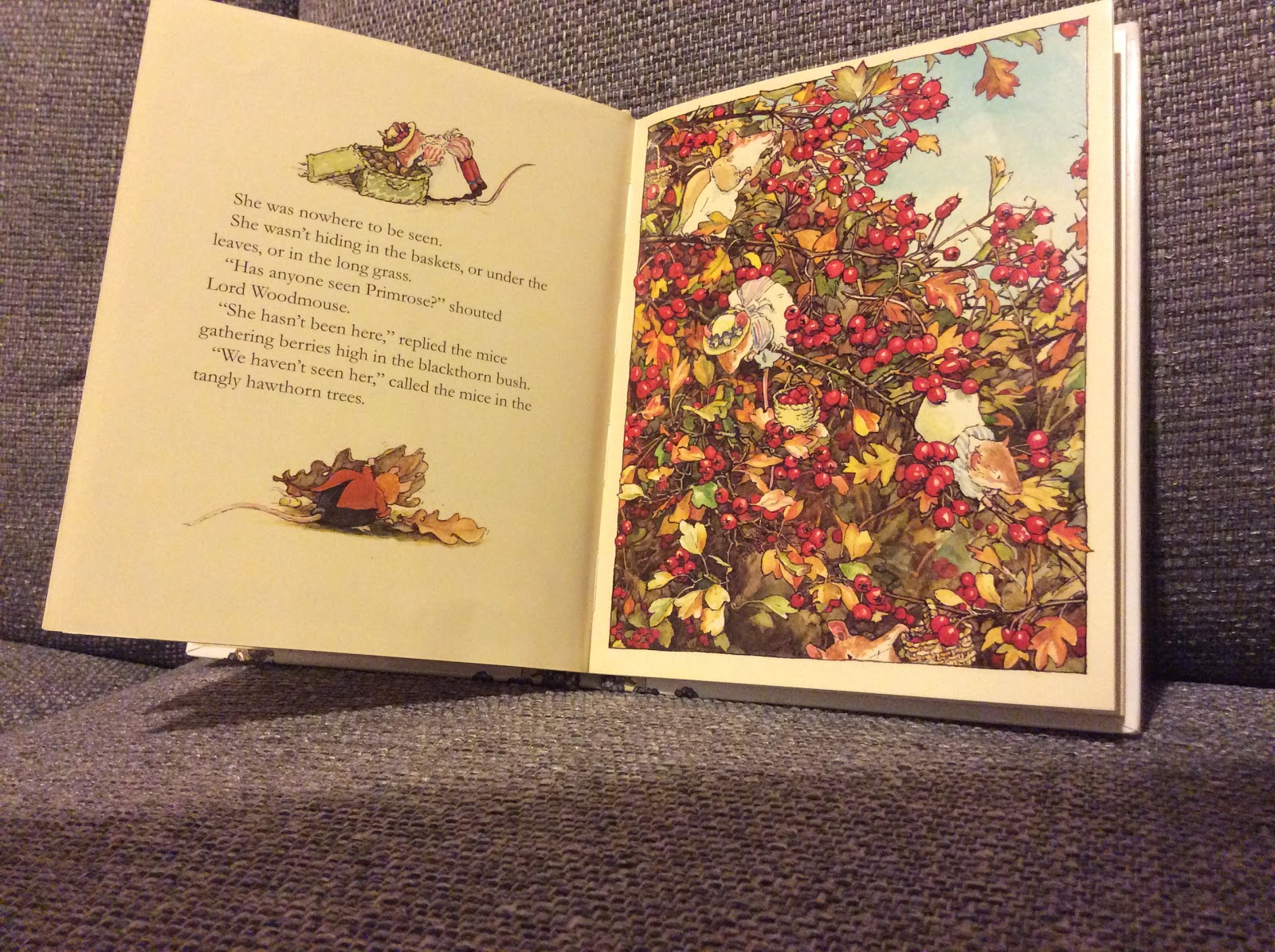


I will be lynched for gender specification here, but Brambly Hedge are really Thomas the Tank Engine for girls. Not to say that only boys like Thomas, and only girls like Brambly Hedge, not at all true, Bert (5) really likes a later book in the Brambly series called The High Hills (1986), but in general, I find the aesthetics and themes of Brambly Hedge really appeal to my daughter, while the aesthetic and narratives of Thomas continue to enthral my son. Again, the two series have much in common: both are about old alliances, community, teamwork, togetherness, friendship and work; both have exciting adventure elements, generally where something goes wrong and needs fixing, or someone gets lost of left behind and needs finding, or an item needs retrieving (against the clock). In Brambly Hedge: Autumn Story for example, field-mouse Primose accidentally strays too far; search parties are sent for her, but she remains resourceful and fortunate, and stumbles on other helpful mouse communities and is eventually reunited with her family.   


What I really like about these books, as does Edie who sat telling me all about this today, is the attention to food, clothes (the materials used), the weather, the smells. The books have quite a sensory appeal, being description rich, vocabulary rich. I also like that they appeal to girls (at least mine!) and have a strong adventure theme, and positive representations of female characters surviving on their own, being skilled and knowledgeable. The tone of the books are a little dated,  particularly in terms of dialogue whereby the characters address each other by name a lot and helpfully talk to themselves allowing the plot to develop. 

All in all, a good quaint 'summer's day in the garden' kind of read. 

If you like this book you might also like:  The Tale of The Flopsy Bunnies by Beatrix Potter


Friday, 24 February 2017

Frankie's Magic Football Series


Author: Frank Lampard / Lamps On Productions
Illustrations: Lamps On Productions
Publisher: Little, Brown Books for Young Readers, 2014-

Whether these books are all completely penned by British footballer Frank Lampard himself, or underwritten by the copyrighted 'Lamps on Production' team is absolutely of no interest on concern to me. Whether Frank Lampard has one of the highest ever IQ scores recorded by Mensa (see his wiki- it's also somewhat of an urban legend when these books are mentioned in the playground), no concern to me. Whether we, as parents, have read the tabloid tattle on Frank Lampard or not, take all this out the equation; this series of books brought reading alive to my boys, and I'll be forever grateful.

At around 5 years old, both Alf ( now 7) and Bert (currently 5) hit a plateau with their interest in reading. The books coming home from school tried their best to engage ( and follow a reading scheme) but they were all so generic and about baking muffins or finding a grasshopper in the garden. Frankie's Magic Football series fills the void perfectly. They're fantasy / adventure stories about friendship, teamwork and football. Frankie, is a school boy who accidentally comes to own a magic ball in the first book of the series, a ball that transports him and his friends back in time or to a different country or place in each book. Consequently my boys would be asking me about Romans one day, space exploration another, and Australia another according to which of the now 18 books in the two series they would be reading. While the context of the action changes, the main four characters in the series are a constant feature of all the books ( Frankie, Charlie, Max the dog, and notably, a key female character, Louise (who is skilled at football, brave and clever- thumbs up on the positive female representation)). 


Physically the books have some, but not many, cartoon black and white images; big, clear 
font and double-line spaced pages; collectable game cards ( perforated) at the back of each book; short chapters and roughly 100-150 pages- all attractive prospects for early readers. In terms of the vocabulary, again this is very well pitched, short descriptions, occasional metaphors, nothing too academic but at the same time there's a good range of words, plenty of adjectives. 

My boys have both found these books are very addictive, and have really risen to the idea of reading through a series. When they started reading these books ( roughly aged 5 and a half) they haven't been able to read these word for word, but the books are composed well enough that if a child can follow the gist of the story, that's enough: the narrative is cleverly summarised every so often and characters remember things and have flashbacks, so children can regain the gist quite easily. Alf and Bert got a real sense of satisfaction from the intertextuality in the series, and delighted in also cross referencing moments in the books with each other.  

To five year olds, the fact a footballer is a writer, talking to them, writing for them, is something very special. It gives these books credence; they are cool and credible even before they've started reading. Getting children to feel positive about reading, and that reading is not just something they have to do at school, but something they can do for pleasure, is hard if the 'appeal' is not there. Frankie's Magic Football series 1 and 2 appeals hugely, so thank you so much Frank Lampard, you helped us overcome the reading glitch and taught my children how to love literature. 


Wednesday, 22 February 2017

The Worst Princess


Author: Anna Kemp
Illustrator: Sara Ogilvie
Publisher: Simon and Schuster, 2012

The Worst Princess is a fun, empowering story and recommended reading for any 3-6 year old girl (and boy for that matter), to help balance out (stamp out!) some of that societal saturation of Disney Princess Syndrome.  
In terms of themes and plot, this book sits like a hybrid between Princess Smartypants  (Babette Cole, 1996) and Zog (Donaldson & Scheffler, 2010). Princess Sue has read all the books on princessly behaviour and attitudes, and she is sat in her tower dutifully (but grumpily) awaiting her prince saviour. When the prince finally arrives (and note, he is so inconsequential, he doesn't even get a name) princess Sue is alarmed to find he expects a conventional princess and takes her to his tower. Enjoying her new-found freedom Sue is angry and searches the skies for an escape plan. She is clever and fearless and on seeing a dragon, she beckons him over. they share a cup of tea and agree to pair up to rid themselves of 'the pesky prince.' The story doesn't end with a disappointing patriarchal nosedive, having an equally kick-ass ending with the princess and dragon causing mischief for 'royal twits and naughty knights'  for ever more, and living happily ever after

What I really like about this book is that the post-feminist princess rhetoric is consistent throughout. Unlike Princess Smartypants, which subverts the princess fairy-tale genre alongside plenty of pastel and pink shades, The Worst Princess is loud, proud and indignant with lots of bright purple and orange, pointy, rough-edged illustrations. At times the prose is bawdy ('twit, royal bum, stupid castle') , and there's a satirical use of ye-olde English font in parts. My Son, Bert, aged 5, likes that the princess scowls, plays with a yo-yo and wears yellow baseball boots (he notices these things!).   


The book has plenty of humour, and laugh-out loud moments at that. Edie (3) loves the part where the princessly shorts are set on fire, and I like the more dry (adult-pitched) jokes about flying 'Dragon -Air', the dragon sniffing nasal spray and the prince putting on a bossy parent voice by referring to Sue as Susan. 
The Worst Princess is refreshing and brash. Its a very welcome addition to our bookshelf, and sits proud and loud alongside all the cutesy, squeaky clean nonsense my daughter also, sadly, likes.  

Saturday, 7 January 2017

The Worst Witch Series


The Worst Witch books ( I have a series of 4, but I believe altogether there are 6 titles)
Author and Illustrator: Jill Murphy (first published 1993, Puffin books)


So I've realised, from my posts so far, that I'm mainly concentrating on what my 1-5 year olds are enjoying. At weekends I'll try to offer recommendations for literature based on what my seven year old boy has been reading on his own, or what we're reading together. 

This week we're trying to get through the last book in The Worst Witch series, as the UK's main children's channel CBBC has an adaption of the series starting this week, and he's really keen to watch it: http://www.bbc.co.uk/cbbc/shows/the-worst-witch

I read these Jill Murphy books as a child, as did some of my friends, and we have many collective fond memories. Initially then,  it felt risky to want to share these books with 7 year old Alf, as if he didn't like them, I knew I would have felt miffed ( and possibly quite old!) Well for us, they haven't lost their charm, in fact I'm reading The Worst Witch books myself now with renewed applause, as I am amazed how easily they've crossed the 'gender gap'. I absolutely hate to say this, as a huge fan of modern children's literature, but I do find a very stark gendered division in my children's literary interests, but in this instance sport crazy boisterous  Alf is happy to read about witch school uniforms (and there's quite a lot of description about this in the books, from tights to hats, lots of black and grey checks!) 

What Alf seems to like, or maybe empathise with at this age, is the female protagonist, Mildred, feeling that she can't ever get anything perfectly 'right'. I think 7 is quite a volatile age for this, with a sudden awareness that there are inequalities in life an in the classroom. Another one of the themes in the series is friendship, particularly having loyalties, and again, I think this is a real concern or 'awakening' for some children at this age. 

So far, in our current read, The Worst Witch All At Sea, there's a good sense of loyalty as Mildred plots to save her Tabby cat from his new fate as a mouse catcher in the witch Academy kitchen. Meanwhile, we hold her other secret, a trip to the seaside looming- but she can't swim!   
Once again, this series really works in that the concerns of the witches echo the concerns, metaphorically at least, of real children. On a practical level, there are good illustrations every 2-3 pages, big sized print, in the editions I own ( Puffin, 2011 copies for The Book People Ltd), and short chapters, very much suitable for budding independent readers. 
Each story has a slightly different adventure, but there is usually a 'calamity scene' involving broomsticks flights, getting told off by scary teachers (the stern Miss Hardbroom), and Mildred in some way saving the day in haphazard and unwitting fashion. 

Rating: For the true nostalgia of enjoying these books myself as a child, I can't help by highly recommend! 

If you like this you may also like: The BFG written by Roald Dahl

Also, The Book People currently have a 7 book The Worst Witch series in stock for £6.99:
The Worst Witch Series to buy-BookPeople

Wednesday, 4 January 2017

Tig and Tog: The Discovery


Written and Illustrated by Sally Garland
Publisher: Top That, 2015

This is a lovely simple story in which dog friends Tig and Tog are playing in the park, Tig is initially reluctant to share her stick, but together the friends make an exciting discovery and work together to uncover more of the surprise in the ground. Tig and Tog have to use various tools to dig up their find. 3 year old Edie excitedly recalled that a wheelbarrow would be used, while 5 year old Bert remembered (with two pages to go) what the big find would be- a dinosaur skeleton!

The story builds up nicely, slowly and quietly, starting with the friends using very basic tools to dig at the ground, sticks in the mud, moving on to spades and then even diggers. The overriding message inTig and Tog: The Discovery is about achieving more when working together and sharing ideas and 'things' (in this case tools to dig, but possessions in general are inferred). That's a useful message to bring to squabbling siblings, or to open up discussion on themes of friendship, sharing and cooperation. My children like the back page of the book which shows a dinosaur skeleton on display, reading 'Found by Tig and Tog with a stick' though it's easy to miss on the outro sheet. 
This is a simple, quiet and charming book, with light watercolour style graphics, sweet but fairly unmemorable characters. The book appealed visually more to female Edie on first sight ( the gendered appropriation of light pastel shades had a hand here I think), but the narrative itself was well received by both 3-5year olds (boy and girl) sharing this story tonight. 

Related Posts Plugin for WordPress, Blogger...