Search This Blog

Showing posts with label 2-7years. Show all posts

Saturday, 11 March 2017

KIDS


Written and Illustrated by: Catherine and Laurence Anholt
Publisher: Walker Books, Ltd, 1992

I feel truly privileged to own a copy of this book. I enjoy reading KIDS hugely, and laugh at the same parts every time (like meeting up with an old friend). The little quips in the book ('here's a kid who hid in some coal' - cue coal dusted child), feel fresh and fun, and despite being written in the 1990s, would be approved as 'PC' even today (I suppose the 'nasty' kids and 'nice' kids might get a bit of a redress in today's classrooms, but my children find these two pages of the book particularly amusing). Generally though being so in line with today's politically correct is incredible really, given that KIDS is about difference and similarity, the sort of topic where what's acceptable and how it's discussed changes rapidly and progressively (on the most part). 


Most importantly with this book, the authors were celebrating and putting diversity on the British children's literature map long before others (with the exception of Janet and Alan Ahlberg possibly, so for example, 'The Baby Catalogue'(1984)), and certainly before this became a part of a wider cultural and political 'agenda'. The differences between kids, as charted in this book, don't feel tenuous or contrived, but natural and not overplayed as those very differences are what kids have in common (nice!)


The book is structured as such, where on each page humourous observations based around a question are made, so for example, 'What do kids look like?' and then there is a reply, in this example 'freckles and badges and ink on their skirts, glasses and smiles and hanging-out shirts.' The Anholt writing and illustrating duo paint this lovely, rich anthology of childhood, showing how gaps in teeth, cuts on knees, getting in a muddle, hiding, stashing items in pockets, having fears, are universal. Alongside the Anholt's signature illustrations (ink and watercolour, detail on clothes, accessories, espousing diversity) the message created is, while kids might all look different there's plenty they do that's the same. 

KIDS is written in iambic tetrameter, so it sounds 'chugging', charging almost. I love that at the end of the book, parent characters are introduced, and they are portrayed as equally diverse, and in a hurry, and busy. On the last page of the book the rhyming verse starts with the letters to spell 'KIDS' in the vertical, and calms the charge right down with 'Kiss us when, It's nearly night: Dads and mums, Switch off the light.' Great memorable way to end and children's book and nice closure for bedtime.


In terms of age range, this book easily spans from 2-7years, and seems more appropriate as my children get older in fact. Alf (7) is all about 'adjective' collecting at school at the moment (this book is plentiful), and he's really starting to explore the concept of difference and similarity against himself - I imagine this is very age appropriate in terms of emotional development. KIDS is a great book for vocabulary building in general though, with the 'verb page' a favourite of mine (eg. 'What do kids do? mix, mess, muddle, comfort, kiss, cuddle'). (Shirley Hughes has a similar technique in her books 'Giving', 'Sharing' etc, as do The Ahlbergs in Baby Catalogue).

All in all, a fantastically educational book, ripe for using in the classroom to support all sorts of grammar exercises, perfect for sharing at home to promote discussion about 'who we are' (see also,If I Could Be),  and a book I like to reach for anytime of the day (like a guaranteed 'pick-me-up') (but preferably with a cup of coffee in hand).   

If you like this book about childhood, you might also like this: Peepo

Wednesday, 8 March 2017

Not Now, Bernard


Author and Illustrator: David Mckee
Publisher: First published by Andersen Press Ltd, 1980. Featured edition published, Andersen Press Ltd, 2012 

Now here's a very dark book. It leaves me with a puzzled look. It takes a jab at parents, or a particular parenting style/ type, or is it taking a stance on children? (should they be 'seen and not heard'?)...and that's why I like this children's book, it's thought-provoking, and really designed as a cautionary tale to adults.

Economical with words, but telling a big story, Not Now, Bernard is about a little boy looking to attract the attention of his parents. He walks from dad to mum, interrupting / interacting as his parents get on with household jobs. Bernard has a knack of speaking to his parents just at crucial moments, so his dad, hammering a nail in the wall in order to put a picture up, bashes his thumb, his mum is watering a pot plant as the pot cracks and drips water over the table. Both parents dismiss Bernard and his mum ignores Bernard's observation that 'there's a monster in the garden.' 'Bernard went into the garden.'  Bernard is then eaten by the monster.


This dry humour then darkens further, as the monster enters the kitchen: the monster is ignored and dismissed by Bernard's mum. A lovely illustration shows the monster puzzled, looking directly at us (the reader). Bernard's father is reading a newspaper, his thumb now bandaged. The monster bites the leg of the father, and the chorus retort is again shouted, 'not now,  Bernard.'   Continuing to show no worry, interest, fear in the monster, Bernard's mother shouts Bernard (who of course is eaten by the monster) to tea. Tea is left in front of the the television (another moment of detachment / practical parenting, depending on your perspective...I expect the author intended the former here, but as a parent of four, I do have a little sympathy for the parents (sorry author David Mckee!). The monster (Bernard himself?) shows signs of being increasingly bored and angry alone in his room. Still ignoring the monster/ or oblivious unintentionally (?) Bernard's mother sends Bernard to bed (the monster obliges).
  
So this is a very intelligent children's book. it makes some interesting suggestions, comments, but leaves the interpretation and inference firmly with the reader (at least I think it does, I might be missing something?). Are Bernard's parents emotionally abusive? They ignore Bernard, he seeks their attention, they don't meet his emotional needs, yet mum has her pinafore on tending to all Bernard's physical needs (keeping home). Is Bernard the monster? His parents are 'genuinely' busy (though are they as the types of jobs they're doing aren't crucial), Bernard is being very needy, and has a vivid imagination (he can see monsters)- is he lying (again?). Does Bernard become the Monster, rather than being eaten by the monster? Is ignoring a 'monster-child' a good way to cope with a 'monster-child', not remarking on the anti-social behaviours? But then, why is Bernard a monster child in the first place?  These are just a few of the questions the book opens up. Its a psychology undergraduate's dream! Themes we could take from this book include, parent-child relationships (attachment theory/ bonding/ interaction), child psychology (imagination, pestering, boredom), neglect, abandonment, abuse, childhood, adulthood, family dynamics, transference... the list goes on.    


On a less analytical note maybe, Not Now, Bernard is a comedy. My children love the parents' voices growling, 'Not Now, Bernard' at their child (especially if you make mum's voice deep too). The unexpected works well to grab interest (in what other book does the main protagonist get eaten by a purple monster?) It's also humorous on the very principle that children don't necessarily 'read' an alternative ending. Tonight I suggested to Bert (age 5) that Bernard is the Monster.  'No', he said, earnestly, 'It said the monster ate him.' 'Bernard is dead forever.' (eek, and my child said that so matter-of-fact!)

Interestingly the book makes Bert feel quite uncomfortable, he's the sort of child that doesn't break rules and isn't 'a bit of the monster'. The book appeals hugely to Edie (age 3) who break lots of rules and loves hearing that others are 'naughty'. On the basis of it's invitation to put on funny voices and the bright, basic pictures, you could easily read this book to very young children (toddlers), but those children of six years and upward, can really start picking at the comprehension and nuances,and the contradictions in this book.
In terms of the humour, it reminds me very much of the macabre disappearance of the rabbit in I want my hat back by Jon Klassen (I wonder whether this story inspired Klassen's dark thoughts there).  
In all, the book feels very blunt, very short and very critical (of society, children, parenting), but I really enjoy that David Mckee has opened this debate, and applaud the fact he does this in a children's story. It is clever, undoubtedly clever.    

Tuesday, 7 March 2017

We're Going on a Bear Hunt


Retold by Michael Rosen
Illustrator: Helen Oxenbury
Publisher: First published by Walker Books Ltd, 1989, featured edition (with CD) 2007

We're Going on a Bear Hunt is more of a song than a 'story' (in the prose sense of story; song's can tell stories of course). This book is lyrical, rhythmic and catchy. It grafts a place on the memory, inside the imagination. It's quite simply a pioneer of modern read-aloud British Children's Literature. 

The narrative sees a family heading off on a walking adventure, an exploration to track down a bear. 'Bear hunt' as the book opens, seems like a fun sing-song, a beat to walk to on the mild summer's day walk. The family are courageous though, and start battling the elements to venture further afield, waist high grass, a deep river, mudflats, a big dark forest, and the most fearsome element of all, an imposing snowstorm. The sense of trepidation grows as the family venture further forwards, repeating the mantra of 'we can't go over it, we can't go under it, we'll have to go through it' on their stoic way. Through the pictures we see the smaller children are carried by the older ones, hair blowing in the breeze, then flapping in the wind, battling adversity 'stumble trip, stumble trip.' And then, a more frightening idea still, a cave, 'a narrow gloomy cave' at that. As the family tiptoe in, they come face to face with a huge brown bear. The 'teddy bear's picnic' or 'follow-the leader' style game the children seem to have been playing is abandoned, and the 'bear-hunt' is suddenly very dark and foreboding with a 'real' bear involved. To the horror of the reader and any listeners, the bear then chases the children, and the story reverts backwards back through all the elements again (but at a faster speed) (three picture strips per page). Eventually the family reach home, running upstairs, with the shadow of the bear chasing them in the door way. Then, a real nail biting moment, 'we forgot to shut the door', and the whole family work together to slam the door just as the bear arrives on the doorstep. Finding the safest place to be / hide in the house, the children race into bed and pull the cover over their heads. A big pink comfy looking quilt enveloping all the children ends the chase, and the bear is the shown plodding back to his cave (alone). Exhilarating.    


Now what strikes me about writing out the narrative of We're Going on a Bear Hunt is that so much of the book is told by the pictures foremost, the text is almost supporting he illustrations, rather than the other way round (which is the convention in children's books, especially at this time).The illustrations (by Helen Oxenbury) depict movement so beautifully, with all the limbs of the children (and their dog) moving in different places, statures in movement positions, hair flowing. The watercolour illustrations in the book offer insight into the conditions the adventuring family face, and these pages in turn are supported by very simple and repetitive use of onomatopoeia to build this description further, so for example long grass sounds and feels, 'swishy swashy', thick oozy mud is 'squelch squerch'. The book also features these chorus-line pages, in black and white (charcoal drawings I think), in which the family are depicted as contemplating their next move, and next tribulation ahead.    


Childhood, and the freedom to explore and 'let be', seems to be a main theme in the book, with sticks in hand for swashing grass and duvets to hide under. Juxtaposed with that are the very solemn and earnest looks on the faces of the family, when they face a new hurdle to overcome. Their expressions grow graver as the story develops, and they start to huddle together in the snowstorm, the carefree river wade far behind them. Whether this is symbolic of a message about growing up, growing together, working through hard times as a family, I'm not sure, I like to think so, but the message my children relay at this point in the story is more one of battling fear, being afraid and wanting to go back (they often point to the baby/ toddler in the pictures, pulling the older sister back).  We're Going on a Bear Hunt is really interesting like that, being chased, going into a cave, stumbling in a dark forest are all the thing of (childhood) nightmares. I think my children are right, it's about conquering fears, feeling safe (at home), and isn't that such a brilliant message? 

In all, I really love this book. It comes with us on many of our own family adventures, as the text is so rhythmic (I don't know the technical term for the beat the lines play out sadly, but the first two lines of every four echo each other, the third and the fourth are the echoed reply), that when we're trekking across fields or walking (by, rather than in!) rivers with the children, one or two of the children often start reciting this book. Bear Hunt triggers so much in the memory. The vast landscapes in the illustrations feel very nostalgic (the flocking birds for example) and the book seems to smell of summertime (with its depiction of light and long shadows, long grass for example). Yes Bear Hunt does contain moments of nightmare, but then fear really etches in the memory (I have a memory of a teacher reading this very book to me as a child and me feeling out of breath and scared as the bear was 'chasing me'). As such, Bear Hunt also stands as an invitation to imagine, to role play, to dream, to explore.  


Monday, 6 March 2017

Shark in the Park!


Author and Illustrator: Nick Sharratt
Publisher: First published 2000 by Reed Educational and Professional Publishing Ltd, featured edition published by Picture Corgi, 2007

I've long thought this book is the perfect five minute light relief for any nursery class, but today this book managed to captivate two seven year olds (Alf and his mate), a tired five year old, poorly three year old and distracted one year old, at a very busy (late) World Book Day event. Talk about working hard! 

It's a very short book, with straightforward (and very effective) structure; an introduction, three 'sightings' and a funny 'outro'. The formulaic action rhyme which charts young boy, Timothy's, moves as he tracks a shark in the park with his new telescope, gets preschoolers moving ( looking up, looking down, looking all around). This is accompanied by an opportunity for a shout, in that Timothy spies a shark in his telescope viewfinder and sets about alerting people, 'there's a shark in the park!' 

The story is fun and well humoured. Timothy spies a shark in the circular viewfinder, this is a cut-away in the page; when the page turns over the black shark fin is revealed to be part of the anatomy of a cat ( its ear), a crow ( its wing) and my favourite, Timothy's dad's quiff. The reveal is amusing, unexpected, and doesn't tire. 


The book illustrations are incredibly bright, well defined and very characteristic of Sharratt. There's plenty to capture the interest of toddlers here, with the inclusion of kites flying in the distance, worms and snails popping up, lots to spot and amuse beyoung the foreground pictures. 

There's a real economy with words in this book, simple four line rhymes mainly, with plenty of dramatic breathe-inhaling exclamations. Speech bubbles are used to bring in the voice of the wrongly 'accused' sharks. There's a fun, cheekiness about the main character, as he smiles and giggles about his mistakes. 

All in all, a fantastic five minute toddler fix, but also a chirpy little book that makes the whole family smile. 

Saturday, 4 March 2017

The Best Chip


Author and Illustrator: Kate Leake
Publisher: Macmillan Children's Books, 2006

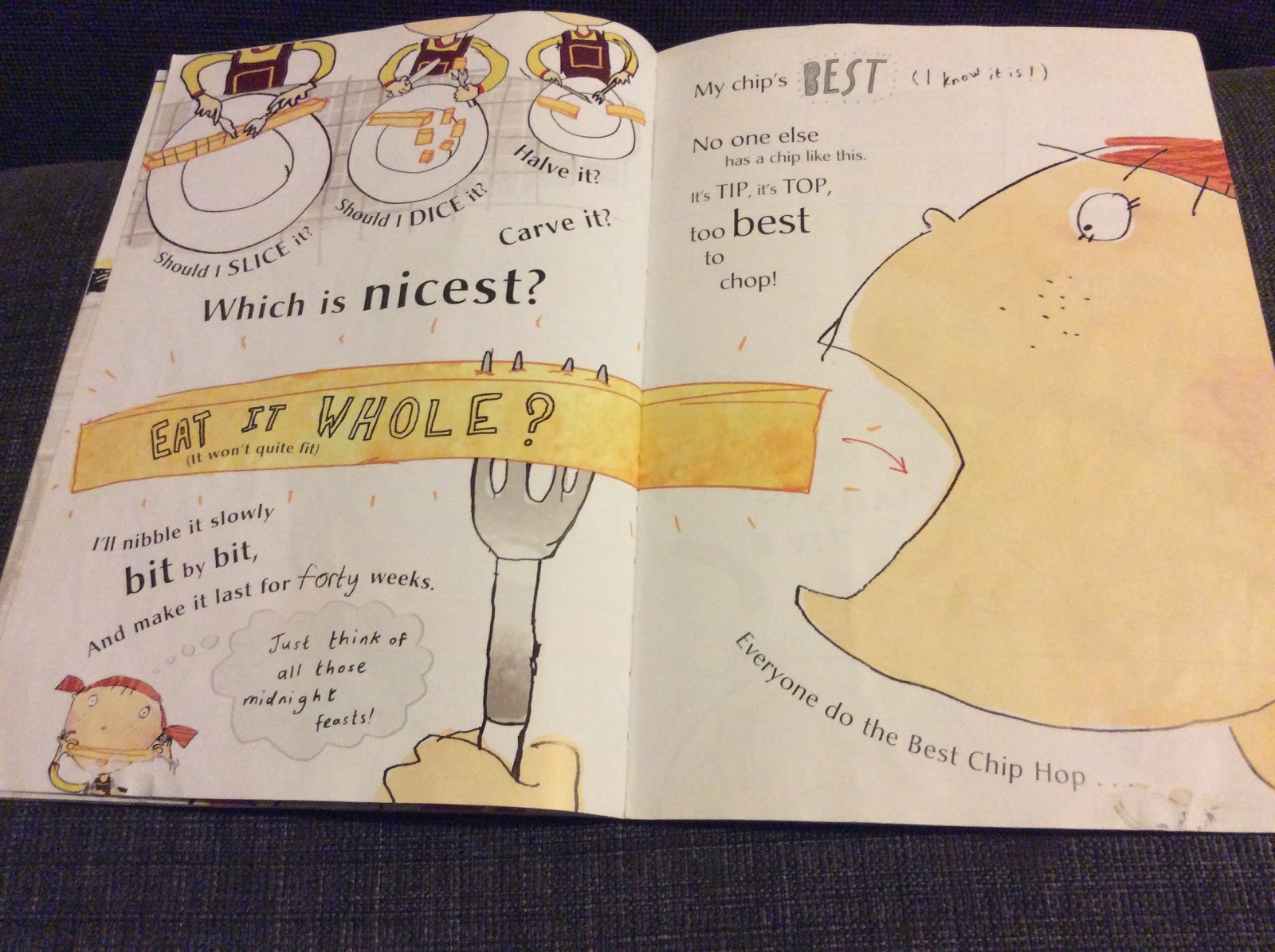
This is one of my favourite books of all time, and quite possibly  #myinheritancebook. If you like modern poetry or even rap, this is the picture book for you. The rhyme is sublime!  It's fast, fun, tells a fantastic story and covers all manner of emotions (exhilaration, excitement, trepidation, sorrow); it's dynamic and comedic, all in one. 

The story rhyme tells the story of a little girl and her family standing in the queue at the fish and chip shop, then being served their chips, and the little girl savouring their taste, their look and their feel and then dropping her favourite chip in the floor. It looks like certain disaster, but the little girl soon recovers when she's served her other favourite food, ice-cream! 


Kate Leake works mastery over words in this book, it's a huge pleasure to read aloud, it rolls from the tongue. She uses alliteration on the 'ch' sound in the opening few pages, which are soft and lyrical. This sense of hysteria around the ' whopper' chip starts to build mid way through, as we're lead through excitement in the first person by the anticipating girl. The pages are laid out in a fun, engaging manner, comic book-like with capitalisation at random 'impact' moments, words in bubbles and sentences scattered uncouthly around the page, the the reader is forced to work hard for the best read, and I like this. 


In terms of the illustrations, again the lay-out and scale of pictures differ on each page and are stimulating on the eye. The children love trying to follow the read with their fingers, but I read this book so much,  they can't keen up, and it becomes even more fun and frantic in terms of reading and chip eating. 

The book works well if you put a touch of performance in, over playing the loss of the bestest chip, with dramatic sobs. Children from 2-7 years love having this read to them. My only very minor criticisms of the book; there's a lot of mild yellow in the pictures, so not so eye catching, and I sometimes feel it's a page too long ( but mainly only if the 'performance' is especially dramatic!- phew, exhausting!) 
All in all, a really lovely book for sharing with all the family. 


Saturday, 25 February 2017

Rosie's Hat


Author: Julia Donaldson
Illustrator: Anna Currey
Publisher: Macmillian's Children's Books, 2005


Here's a book with a great longevity; enjoyed from the age of 2 years to 7 years in our house. At 2 years, children enjoy the onomatopoeia in this book, with capitalised noisy words used to express the story; 'PATTER, PATTER! SQUEAK, SQUEAK!' At 3-5 year children start to understand that the hat in the story, is instrumental to all the characters, somewhere to hide for a mouse, used to build sandcastles for some boys, becoming a nest for some birds. From 5-7 years children enjoy the cyclical journey the hat makes, eventually being returned to its rightful owner, Rosie. From about four years children come to understand that Rosie ages and becomes the firefighter, and it's a lovely moment to talk about,  this understanding of generation, moving on, growing up, but loved items from childhood, and memories, still being there. Julia Donaldson revisits this theme latterly with her beautifully sensitive book, Paper Dolls


Anna Currey's watercolour and pen illustrations in Rosie's Hat are very soft and flowing; they capture the ebb of the wind and waves nicely, supporting the theme of 'coming and going'.  I also like that Currey plays with the 'in/consequential', so for example, the seagulls eating the fisherman's lunch, Rosie and her parents in the background of the beach scenes searching for her hat and leaving the beach. The illustrations also use character consistency, the fisherman, for examaple, later returning to the beach with his grandchildren, taking the photo of Rosie and her hat, and her loaning her firefighter hat to a child, to again stimulate this pattern of coming and going. 


This book reads aloud well, and its quiet in nature, soft and lilting, so very calming and gentle at bedtime. The story is also soothing; Rosie looses her hat accidentally, on a sudden fateful breeze, but is reunited fortuitously with her hat, though by this point she has grown and found her path in life, having her own firefighters hat. This, like in Paper Dolls, is a nice metaphor for many possible themes and opening for discussion with children, about bereavement, memories, loss, and simply moving forward after painful moments. 


Tuesday, 21 February 2017

If I Could Be


Author: Pippa Goodhart
Illustrations: Nick Sharratt
If I Could Be is a double edition of the books You Choose and Just Imagine 
Publisher: You Choose first published by Doubleday in 2003, Just Imagine first published by Doubleday in 2012. If I Could Be first published by Doubleday in 2014. 

My three oldest children (7, 5 and 3) were sprawled out on their bellies on the landing this morning, 'choosing' together from this book, and discussing, with great excitement, their selections, so I felt If I Could Be deserved a post tonight. This book wouldn't be my first choice of bedtime story, but it is the first choice always, of Bert, 5 and increasingly Edie, 3. It isn't my choice, as basically the book involves giving children categories of goods or ideas to select from which generally involves a lot of procrastinating, thinking, changing of minds, and draws out bedtime no end! If you've got a lot of time on your hands, a long car journey maybe, and you want to stimulate discussion and get into the mindset of your child, this is the book for you. 

The first section of this double edition, You Choose, offers scenarios to choose from, generally stooped in everyday life: so based on what to wear, how to get there, what to eat and what to do. On each double page spread of this large hardback there's a bright background colour and busy page of images, with a question posed at the top. There's a tentative link through the themes, so choosing where you would live moves into what you would put in your house? At 5 years old, Bert has started to make relational choices, so for example he matches his choice of riding round in a VW Beetle on the transport page, to selecting a flower T shirt on the what to wear page, saying that people who drive beetles like flowers. This book is fantastic for getting children to argue, discuss, share their thoughts, claim ideas and express themselves. It can be frustrating for children with limited vocabulary though, unless you share as a very patient parent happy to point and smile and not impart you own ideas on every page. 

The second book in the double edition is Just Imagine: this one tends to have more fantasy scenarios, such as asking children to imagine being small, or not human, or being magical. In terms of building vocabulary this book is fantastic, as there's so much to see, label, infer, relate and categorise. While there may not be much to physically 'read' on each page, the book is promoting these basic reading skills all along. 


Nick Sharratt's illustrations work so hard in this book. They are all equally bold and bright, with no obvious a emphasise or stand out pictures. Control and decision making is really handed over to children with this book, making it suitable for building attachment relationships ( thumbs-up as adoption friendly though beware of the 'choosing your family' page; we emphasise the 'choosing friends' angle harder on this page). 

In all, a fun, exciting book that would make a good addition to any classroom, nursery, or home bookshelf. It's interactive angle means you need to choose wisely when to read. This is a noise- inducing book, and a book for sharing ideas ( not calming!) - prepare for sibling squabbles and fall-outs over claims to ideas, but equally prepare for being invited in on those funny and touching moments, such as when children suggest items or ideas for each other ('Edie would love those flip flops' suggested Bert this morning, 'and I would like a pet lion and three robot dogs please!' Edie replied). If I Could Be is like a ticket into your child's imagination, a mirror to shine at phases of child development; it promotes creativity, drama, independent thinking, matching skills, critical thinking, selecting...it's a very very useful book.  


Saturday, 21 January 2017

Tyrannosaurus Drip


Author: Julia Donaldson
Illustrator: David Roberts

Publisher: Macmillan Children's Books, 2007

This is Julia Donaldson at her very best. An exciting 'underdog wins' story wherein a vegetarian duckbill dinosaur egg ends up in a Tyrannoasaurus nest. The hatchling does his best to fit in with the meat eating T Rex family, but instinct takes over and the T Rex family want to hunt while the duckbill runs away. 'Drip' as the duckbill is named, accidentally discovers his heritage and then saves the duckbill herd from being eaten by grisly and grim T Rex's when they strike lucky with a new way to get across the river. 

The illustrations in the book are a little chaotic, and according to my five year old tonight, 'don't look enough like real T Rex to be a T Rex' ( the caricature of small arms, sharp teeth, claws don't really go alongside the pink plump bodies), the rhyming narrative is fantastic though, and just rolls into rote. Children probably get slightly more out of this book if they understand a 'reflection', in that dad T Rex falls into the river after seeing his, but the way this book reads aloud (sumptuously) means it's suitable for a broad age range (as is the case with most Donaldson books, the secret, in part, to her success I think).  

I'm not sure the book promotes any helpful messages, 'nature over nurture' (not sure I agree with this one), 'running away to find oneself' (not a message I'd normally advocate in a children's book), the tearful looking T Rex family on the back sleeve always rouses sympathy and questions from my children too, 'what happens to the T Rex family mummy, do they find food?' So possibly not the most well thought-out children's book, but in terms of oral and aural readability - divine. 
Related Posts Plugin for WordPress, Blogger...