Welcome to WhatFredRead, a blog for people looking for recommendations, reviews and celebration of books for young children. I am the mum of four young children and I have a passion for children's literature. This blog is my new year's resolution, to share our daily reads. WhatFredRead is brought to you by 30-something me and my trusted panel of critics aged 7,5,3 &1.
Search This Blog
Showing posts with label friendship. Show all posts
Tuesday, 22 August 2017
Home
Author and Illustrator: Alex T Smith
Publisher: Scholastic Children's Books, 2009
I discovered this book in a weekly library haul; shove as many books in a calico bag in between swimming lessons and getting the kids home for tea, library trip enroute, don't ask questions just try the book stash out, one by one, at home. The best books are read more than once, the very best books go on a re-loan, and exceptional books are returned, and a forever copy bought online within a week. I think I had ordered a forever copy of this book within an hour; as my now eight year old says, 'it's epic.'
Home is a book about friendship, and what it means to feel 'at home'. Four unlikely friends, live contently together, until their aspirations and interests in life lead them to yearn for different things; wanting to be a pirate, wanting to yodel in the mountains, a desire to live in a dark cave and aspirations of life in the big city, going to parties. The cartoon critters, a badger, bear, deer and rabbit, discuss, argue and then fight, eventually deciding to go their separate ways but all taking a physical piece of the share house with them; the floor, door, windows and door. Each animal is seen going off in a huff, determined to take their part of the house with them. Double page split images work to great effect here, with the landscape backdrop differing to exaggerate the different destinations of the characters. Eventually the creatures realise and admit they've made a mistake, find resolution and resolve to return and apologise to each other: fantastic! The perfect model of any friend and / or sibling relationship.
This is a fast paced and witty book, feeling very original in its togetherness -separation and
'reunification with adjustments' storyline. The tone of the book is very 'matter of fact' rather than urgent and concerned, which makes the story very funny, presenting the obscure events, such as the pompous and bossy badger wanting to 'boogie woogie' all night long, as everyday. I especially like the jibe, 'it was as if they had never seen a badger boogie-woogie before!' emphasising how alien a new beginning is for the friends, away from each other, as they conclude that the new starts all have drawbacks, with the badger for example, finding that people in the city 'weren't friendly.' As with most of his work Alex T Smith makes great use of societal references and stereotypes here; he's a great author-comedian in my mind.
'Home' is full of the unexpected, and yet the message is one of familiarity and belonging. It's a great book for young children in that it promotes feeling secure and concludes that 'home' doesn't need to be a static 'thing', physically a house can change its shape and form but it's the relationships that drive the home that count. A great book to use for children moving house, and also for talking about attachments and belonging. Aside from all this, just a fantastic book to read aloud. Assign each character an accent and have fun performing this one- it's pure comedy, laugh out loud.
Tuesday, 18 July 2017
The Diabolical Mr Tiddles
Author and Illustrator: Tom McLaughlin
Publisher: Simon and Schuster, 2012
This book made my eyebrow ache, as it was arched to one side throughout, trying to guess where the goof-ball story was going next. The Diabolical Mr Tiddles is a delightful story of loyalty, friendship and...the benevolence of Her Royal Majesty the Queen?! Birthday boy Harry gets his dream gift, a cat, whom he comically names Mr Tiddles. Harry lavishes Mr Tiddles with affection, and Mr Tiddles wants to repay the friendship. Initially, as cats do, Mr Tiddles brings Harry and mouse, but after this receives a reaction he wasn't expecting, increasingly exciting and expensive gifts start arriving in Harry's room, but where are they from?
In a fun twist to the story, it turns out that the rotund, ginger, stripey cat Mr Tiddles, has been on some jaunty night escapades stealing items to fulfil all boyhood dreams; a horse from a cowboy, a pogo stick, rockstar guitars; there's a great picture about half way through the book showing this extensive and growing collection, great fun.
Tom McLaughin then spins the story upside down again, when Harry follows the perpetrator in this nightly wanderings, ending up face-to-face with the Queen, in her bedroom, of all places!
When reading this to Bert (5) and Edie (3) in the week, Bert immediately spotted that the queen slept with her crown on her head. Little details in the book, like this, are plentiful- comedy treats abound for eager eyes. I really liked the way the queen was presented, as this austere bossy mother character. The message in the book, you can't by love, nor friendship, and that true friends look out for each other, is sweet, a tiny bit lost on the nearly four year old, but well understood by the five year old I felt. The endnote illustration of the queen is amusing, and the cheekiness and neediness of Tiddles throughout, raises a calamitous beat. A great read for settling trading card fractions in the playground, or more generally to read to preschool and reception children navigating new friendships.
If you like this, you'll also undoubtedly like 'Love Monster':
https://whatfredread.blogspot.co.uk/2017/06/love-monster.html
Friday, 23 June 2017
Badger's Parting Gifts
Author and Illustrator: Susan Varley
Publisher: Collins Picture Lions, HarperCollins, 1984,edition featured 1992
This children's picturebook is a gentle, honest book about death, and coming to terms with grief. There's a sensible narrative about an old badger, quietly preparing himself for parting by readying a letter to his friends. Badger is presented as happy, ready and willing to pass away, watching his friends Frog and Mole run spiritly down a hill, while he feels old and tired. Full of appropriate simple adjectives about aging, the book steers away from gloominess, though at the same time is open about the grief that those left behind then feel.
The death 'scene' itself describes badger 'falling out his body' and running down a long tunnel, which, while somewhat cliched, is a useful, comprehendable anology for young children. One of Badger's friends, Mole, takes the news of Badger's death, harder than the others. Winter then sets in, passing into spring, which is a nice way of indicating to children that an amount of time suspended in this sadness has passed. The creatures then individually have memories of Badger teaching them to do things, so Mole remembers Badger teaching him how to make a paper chain, Frog remembers Badger teaching him to ice skate for example. These memories and teachings are of course, 'Badger's parting gifts', and the book ends with Mole on a warm spring day, on the hillside, looking up at the sky and thanking Badger for these gifts ( and we're reassured that Badger can hear him).
Sensitive and warm then, the narrative is reassuring rather than worrying and dwelling. Yes, there are slightly sugary moments of cliche, tunnels, clouds, seasonal change and the illustrations are soft and floaty, ink and water colour, not necessarily memorable. But all in all quite a helpful book for illiciting thoughts on death, discussion about death with preschoolers and young children.
Labels:
3-7 year olds,
ageing,
badger,
bereavement,
death,
emotions,
friendship,
generation,
grief,
memories,
mortality,
old,
seasons,
Susan Varley
Monday, 10 April 2017
Winnie the Witch
Winnie the Witch
Author: Valerie Thomas
Illustrator: Korky Paul
Publisher: Oxford University Press, first published 1987, edition featured (25th anniversary edition) 2012
This book, Winnie the Witch, is the original from a series of now 15 picture books all featuring lovable, ungainly witch Winnie and her loyal pet cat, Wilbur. We have 10 of the books in this series, and they're a favourite with my children when in their preschool year. With slapstick humour, involving lots of clumsy Winnie tripping over her cat, and a reluctant Wilbur doing things he's not necessarily happy about, going under the sea, going up in space for example, the books hit the funny bone of this early years age group perfectly. So much so, books in this series are frequently chosen by my daughter (3), to bring in for 'Show and Tell' at nursery (I expect she gets a guaranteed laugh as Korky Paul's illustrations of erratic Winnie tell the story nicely in themselves).
The illustrations, being self contained, remind me of graphic novel illustrations, with the attention to detail in the architectural backdrop (I love Winnie's complicated black Gothic castle). There's also a story arc through the series, in that we see some members of Winnie's family more than once, and we also get reminders of what what Winnie and Wilbur like and in Wilbur's case, dislike: there's a consistency here that empowers young children inviting them to recall and remember. Likewise, there's a consistent lead-in to Winnie casting a spell; my daughter loves to join in: 'she picked up her magic wand, waved it 3 times and...'
On occasion the layout of the double page spread is a bit confusing, especially in this original title, as at one point there's a horizontal spilt page (it frustrates me ever time that I read aloud the wrong section first!). Some of the double page spreads are used really well though, being awash with watercolours for the casting of spells for example.
The story line of each book is very formulaic (but why not, it works so well), generally involving Winnie being clumsy and accidentally messing up a spell or over-dreaming an aspiration. She then goes about righting her wrongs, with her black cat in despairing pursuit. The general message of each book is that friendship lasts out, problems always have solutions and mishaps can be remedied. In this edition of the series, Winnie the Witch, Winnie is fed up with Wilbur being a black cat whom she fines hard to see in her black house. Winnie, casting a spell, turns Wilbur green, but then when he's outside on the green glass, she can't see him again (in another book in the series Winnie's terrible short sightedness is confirmed!) A witch's solution to not seeing seeing her cat, is of course, to turn her castle multicoloured so her black cat stands out. Such simple but clever solutions and happy endings run throughout the series.
What my daughter seems to love about this series, is the very honest and human quality of Winnie (the same reason she's really starting to get into The Worst Witch TV Series on children's television channel CBBC, and for that matter I hear Winnie and Witch herself has been made into a children's cartoon series on Channel Five (Milkshake) but haven't caught this yet. (Your thoughts are most welcome). Each book charts Winnie's mood quite nicely, showing how she feels sad and empathetic toward Wilbur when he's teased by birds in a tree for being so colourful for instance. With this depth in a protagonist, you can see whythe series seems to have a really strong, and now generational, fan following. There's also a lot of movement in Korky Paul's witch depiction, with Winnie's beads often being shown as flying everywhere. I also like Winnie's scatty flyaway hair and what looks like a rushed application of black lipstick. Winnie is a fun and uncouth witch character, gangling, grinning, always trying her hardest (oh yes, much like Jill Murphy's Mildred Hubble (The Worst Witch Series ) aimed at slightly older readers).
And if that wasn't all enough to draw the attention of the preschooler, the front and back endpapers of each book in this reissued 2012 Winnie series, include fan art. My children love examining these pictures and then playing, 'guess the age of the child artist'. regardless of age, these pictures have inspired our own Winnie art creations (as the children were really keen, given the endpaper above, to try out pastels on black paper too).
If you like this book, with a strong female protagonist, you might also like: The Worst Princess
If you're a fan of Winnie the Witch, here's a the OUP endorsed Winnie website: Winnie and Wilbur.com
Friday, 7 April 2017
Ernest
Author and Illustrator: Catherine Rayner
Publisher: Macmillan Children's Books, 2009
This is a fun, three-minute read for preschoolers. The concept, a 'rather large' and 'very determined' moose called Ernest puzzling over how he might fit himself into the book, feels original. The quirkiness increases once Ernest's 'little friend has a BIG IDEA!' (to make the page larger by sticking bits of paper together, simple and effective).
The chipmunk friend and Ernest are, interestingly, both silent characters, with a third unseen narration voice. In that respect the book is a little reminiscent of the American classic 'if you give a Mouse a Cookie' by Laura Numeroff, illustrated by Felicia Bond (1985).
What's lovely about this book is the utter simplicity of the story, but the big punch of a message it leaves behind. Firstly, the little friend is always there, tireless in her efforts to help Ernest.
Ernest also tries hard, using all his efforts to contort himself onto the page. On first reading, we don't really appreciate what the creatures are trying to achieve, as we only see a fragment of Ernest the moose, a little at a time, so we can't really appreciate his true size. The book is humorous in this way, on one page, we see just his bottom, on another 'Ernest's middle fits in easily, but what about the rest of him?' The use of rhetoric directed at this young audience is again, fun; my children certainly try to offer suggestions to these questions 'get a digger!' (their standard line to most things).
In terms of the writing, less is certainly more here, so very in keeping with the message of the book; 'good things come in small packages'. Each page carries one short line, and there's some lovely vibrant verbs in use, namely 'shimmy, shuffle and shunt' mirrored on the next page by 'squidge, squodge and squeeze.' Capitalisation and different font sizes are also abundunt.
The illustrations are initially very modest, simple multi-tonal browns and beige against a light green background, but looking closer there's a lot of texture in the pictures with crayon in part and cracked oil paint behind pencil and pen on top of that. The final page, the solution to fitting Ernest in the book, is a fold out approximately A2 size page. This big reveal is incredibly exciting for little ones, not knowing what's under the folds (maybe a slightly gimmicky ending though). Equally, a large loose page is not safe with toddlers, and our version of the book has ripped many many times. I've sellotaped it together, which in way, just authenticates the story-line, as the chipmunk has sellotaped extra paper into the page in order that Ernest can fit.
In all, a book about persistence and will power getting you where you want to be, a moral about not giving up and a parting message about friendship in that dear friends stand close and help and support us to the very end.
If you like this you might also like: Shark in the Park by Nick Sharrat
Labels:
2- 5 years,
animals,
Catherine Rayner,
chipmunk,
determination. preschooler,
folded-page,
friendship,
gimmick,
moose,
original,
silent characters,
simple,
small things,
third-person narration,
toddler,
togetherness
Wednesday, 29 March 2017
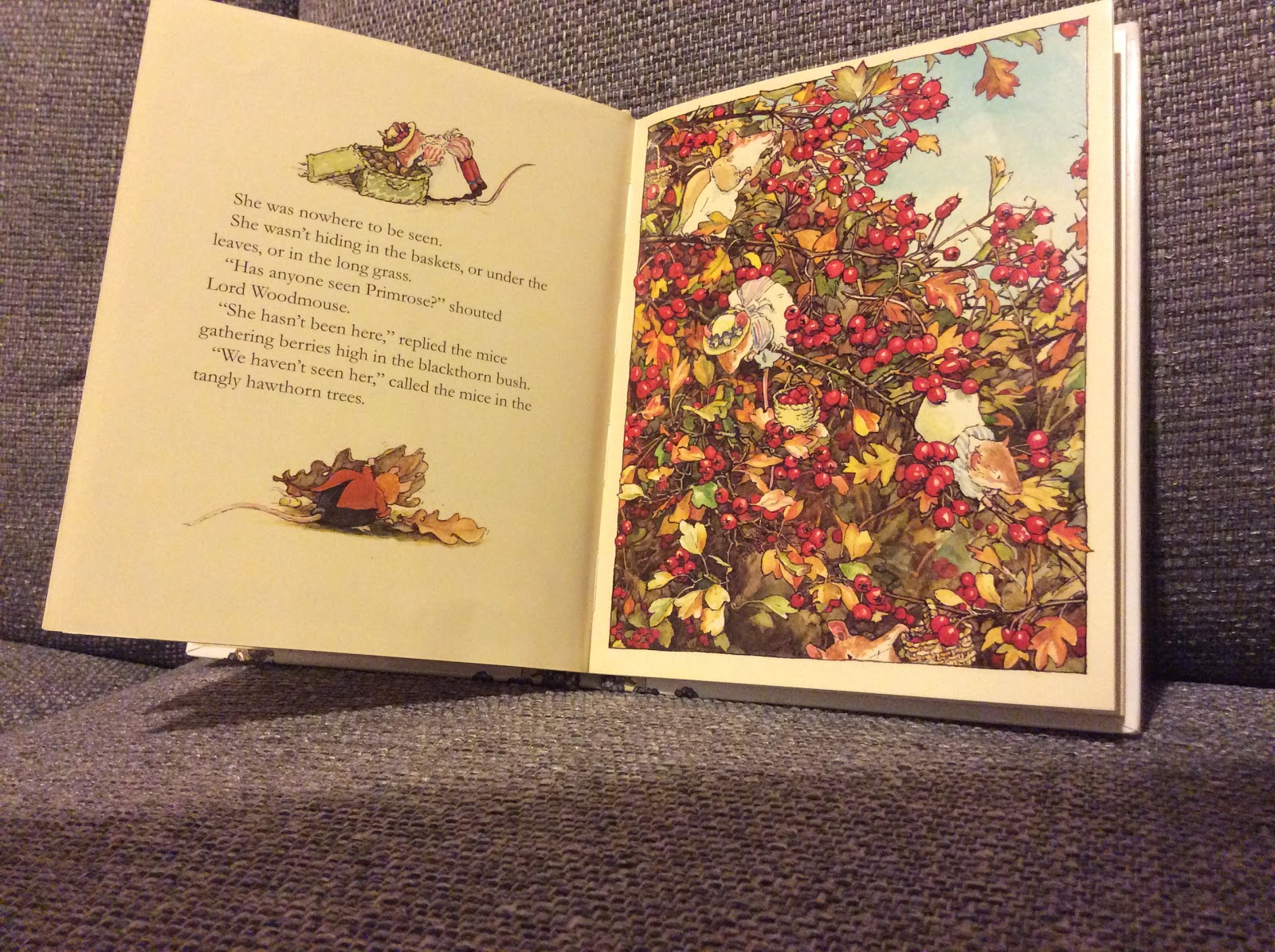
Brambly Hedge: Autumn Story
Author and Illustrator: Jill Barklem
Publisher: HarperCollins 1980
Acquired: School Fayre
My daughter, Edie, (approaching 4 years of age) plonked Autumn Story on my lap today and said, 'I know it's long, but we've got all day'. Well what can you say to that?!
The book isn't 'long' per say, just quite wordy and descriptive, but that's part of the charm. The Brambly Hedge books are, to me, a hybrid between The Beatrix Potter Collection and The Thomas the Tank Engine series. They capture the essence of the British countryside in incredibly intricate illustrations like Potter, in attention to rural traditions, native animals, birdlife, insect life, flora and fauna just like Potter, and they're written in this slightly stiff, posh voice which hoots of Received Pronunciation. Characters are introduced by their titles, Mr Apple, Lady Woodmouse, Wilfred, and this espouses a sense of position and place in the social class hierarchy. Potter was slightly less oblique in doing this I'd say, some of her characters have more of an accent (Jemima Puddleduck) or aspire to great things (Mrs Tabitha Twitchit). And the similarity to The Rev W Awdry's Thomas the Tank Engine Series? In a similar vein to Brambly Hedge, I can read these books aloud and completely switch off to the story, sleep talk them almost. It's possible to read both series of these books so mechanically and yet still my children seem to enjoy them and beg for more! I have long thought that reading Thomas the Tank Engine at any time of the night or day would cure even a hardened insomniac.
I will be lynched for gender specification here, but Brambly Hedge are really Thomas the Tank Engine for girls. Not to say that only boys like Thomas, and only girls like Brambly Hedge, not at all true, Bert (5) really likes a later book in the Brambly series called The High Hills (1986), but in general, I find the aesthetics and themes of Brambly Hedge really appeal to my daughter, while the aesthetic and narratives of Thomas continue to enthral my son. Again, the two series have much in common: both are about old alliances, community, teamwork, togetherness, friendship and work; both have exciting adventure elements, generally where something goes wrong and needs fixing, or someone gets lost of left behind and needs finding, or an item needs retrieving (against the clock). In Brambly Hedge: Autumn Story for example, field-mouse Primose accidentally strays too far; search parties are sent for her, but she remains resourceful and fortunate, and stumbles on other helpful mouse communities and is eventually reunited with her family.
All in all, a good quaint 'summer's day in the garden' kind of read.
If you like this book you might also like: The Tale of The Flopsy Bunnies by Beatrix Potter
Labels:
adventure,
animals,
birdlife,
British countryside,
community,
friendship,
girls,
Jill Barklem,
native species,
nature,
outdated,
positive representations,
reunion,
survival,
traditions,
vocabulary building
Sunday, 26 March 2017
BANANA!
Author and Illustrator: Ed Vere
Publisher: Puffin Books, first published in 2007, board book featured edition 2008
My eldest child, Alf, is 7 years old and loves a spot of drama: thanks Ed Vere, I feel you contributed to this. BANANA! came into our house when Alf was a few weeks old. With a sparse collection of children's books in the freshly painted nursery, we reached for this board book, again and again. At first we didn't really get it, the book nor the baby. The baby didn't do much but we thought we should probably read to it. The book didn't say much, but we thought we'd better read it. the basic synopsis- two monkeys, one banana, two words (banana (capitalised and followed by various modes of punctuation- !,?,!!) and please (followed by - ?) So instead we 'read' the pictures. This involved describing the pictures at first...no interest from baby. This then evolved into enacting the monkey's gestures (arms aloft, see picture below), making the blase whistling noise for monkey-not-noticing-pleading-monkey (again, see below)...sudden flicker of interest from baby.
Okay, so there we had it, BANANA! was a book to be performed! 12 bright double page illustrations telling of the complex negotiation around the eating of one banana. Simple and effective. Sometimes my partner and I (newly doting parents might I add) took on reading roles; one of us would be monkey one (stripey red T shirt monkey) who takes to tussling for the banana with monkey two (stripey blue T shirt monkey). Except this would often end in a fight as red monkey, having the epic tantrum on page 5 (see below), was a far more interesting performance role to play compared to blue monkey, who's a bit of a goody goody, and is the first to agree to share.
This book taught me many things. It's a masterclass in 'less is more'; short,colourful and economic with words. It taught me that a good story for young children, is about the performance and delivery as much as a narrative. BANANA! pushes the adult reader to interact with their audience; to imply, interpret, gesture, offer, initiate and model behaviours in order to tell the story (its an impossible book to simply read- too few words). Indeed BANANA! facilitates the basics of learning to read beautifully, asking that the reader interpret the pictures, recall events, and 'read the illustrations' in order to follow and impart the gist. BANANA! is funny, and engaging; it seems the bigger the read-aloud performance of this book, the more of a reaction you get from children. Having been a fan of the book for 7 years now, my version of the monkey tantrum is raucous, big movements, big facial expressions, gets lots of giggles. Its an enjoyable book and a joy to share.
This book also has a huge amount of educational scope. It helps promote giving names to emotions, labelling and identifying different emotions even for children at a very young age. BANANA! is so simple I would suggest it's suitable for babies, toddlers even through to preschoolers, it might even have a place in a SEN library, and we certainly use this one to open discussion on emotions with regard to the children's adoption. Currently our baby of the house, George (20 months), stares in bewilderment at us, trying to fathom why we pretend cry when we read this book, why we storm off, why we smile at the end. It's a great book for being playful, role playing emotions, and as such is good for building attachment, for bonding, for showing parent-led emotions, and so I would also recommend this book as a resource for Theraplay.
And finally, as if that doesn't pack a big enough punch for a 12 page board book, the final parting message of the book is to share, with the monkeys agreeing to disagree. This is a great way to end off a toddler board book, future proofing any sibling encounters along the way. And of course, throw a bit of maths in there for good measure too, as the monkeys and their banana halves mean "two halves make a whole"- fantastic, genius! For a book with just two words, BANANA! says so very much.
BANANA! should also come with a warning though: my children frequently choose this title to 'read' to their youngest sibling, as it always raises a laugh: performance styles can vary and budding actors develop their own interpretation (usually the style known as 'over-the-top'. Given this, I wouldn't always choose this book at bedtime, as it has been known to 'hype' the children up. In all though, a big monkey thumbs up to Ed Vere for this humorous, clever offering.
If you like this book, you might also like this 'performance' reliant board book: This is the Way by Charles Fuge
Labels:
1- 2 years,
1-18months,
1-3 years,
adoption-friendly,
baby,
baby- friendly,
bananas,
dramatic,
Ed Vere,
emotions,
friendship,
interactive,
invites interaction,
monkey,
performance,
SEN,
sharing,
toddler friendly
Thursday, 9 March 2017
Handa's Suprise
Author and Illustrator: Eileen Browne
Publisher: Walker Books, 1994
This is a sweet, very simple story, set in south-west Kenya. It features a little girl called Handa (as the postscript notes, from the Luo tribe in Kenya). Handa goes off to see her friend Akeyo, packing seven types of fruit into a basket as a surprise for her friend. Handa walks purposefully to Akeyo's village, the fruit in the basket balanced on her head. As she walks she thinks about which fruit her friend might choose to eat first. Unbeknown to Handa, a monkey slips down from a near tree and takes the banana from her basket. Handa wonders whether Akeyo would like the 'sweet-smelling guava', just as an ostrich sweeps in to take the guava. A zebra takes the 'round juicy orange', an elephant the 'ripe red mango', a giraffe the 'spiky-leaved pineapple', an antelope the 'creamy green avocado' and a parrot the 'tangy purple passion fruit.' As Handa approaches Akeyo's village a goat breaks free from its rope, bangs into a tree and tangerines from the tree fall into the basket. Handa announces to Akeyo on meeting that she brings a surprise, but the story ends with Handa being the one who is surprised.
In terms of age-range, this book works well with toddlers (and must surely sell well and do well in board book format?). It is very simple, very soft and calming, very repetitive. It's good for vocabulalry building, especially of fruits and animals. The book is a bit to straightforward and repetitive to interest slightly older children I think, trying to spot and name the animals brings interest to the three year olds, but by four my children at least, have proclaimed to have grown out of this story. Handa's Surprise inspires a vast array of supplementary reading activities online though, so the longetivity of the book could be easily increased.
In all, this is a short, cheerful book offering insight for young children into a way of life in a specific part of Kenya. It gets the thumbs up as a read which embraces diversity.
Sunday, 26 February 2017
Tales of Robin Hood: Robin and the Silver Arrow
Author: Damian Harvey
Illustrator: Martin Remphry
Publisher: Franklin Watts, Hachette Children's Books, 2006, The Hopscotch Series
I've recently put a polite request in with our local library to please consider buying more of these Hopscotch Series of books as my boys (5 and 7, and increasingly so my 3 year old girl) absolutely love this collection. Over the past couple of years, we've borrowed and read the Tales of Robin Hood, the Stories of Sinbad the Sailor through this range, and some about legends or historical figures such as BloodAxe Eric, Blackbeard the Pirate, Sir Gwain and the Green Knight (Tales of King Arthur), Mary Seacole, Guy Fawkes to name a few. I imagine the true series range is huge, sadly our library and all the local libraries from which I also requested, have incomplete books in the series ( and we live in a big city for the UK). What a shame for all that the number of books obtainable from the Hopscotch series free in our libraries is sadly limited. Moreover, they don't seem to carry this series at my children's school either, which again, is a real travesty. Seems such a pity as this series makes reading rock!
From an educational point of view, Hopscotch states it is 'specially designed to fit the requirements of the National Literacy Strategy, aiming to develop children's reading skills' and carries the 'series advisor Dr Barrie Wade, Professor of English in Education, University of Birmingham' . As I've stated before on my blog, I can't officially comment on the educational value of children's books I review, as I have no training at this age range, but whenever I finish reading a Hopscotch book, I always personally feel I've learnt something (mainly about a historical figure).
In this title, Tales of Robin Hood: Robin and the Silver Arrow, there's a good mix of dialogue and narrative, enabling early readers to try out expression. The illustrations are a little fussy perhaps, but they are laid out pragmatically, allowing roughly three or four sentences maximum per picture. The use of thought bubbles helps emerging readers follower the storyline, and place themselves in a authorative and knowledgeable position as storyteller. All the books I've read in this series follow the same very useful and purposeful logic. Themes and vocabulary coming out of this title, as an example, are: disguise, competition ( in relation to a tournament), the den and merry men (working together as a team and having friends). This pitch is again typical across the series.
Using a very familiar folk legend, Robin Hood, children come to the text with some existing expectations. As an adventure story, they seek action-filled, but in way of critiquing this particular title, I would suggest that there are maybe too many characters introduced all at once: Robin, Will Scarlet, little John, Much the Miller's Son, and the Sherriff all in just 31 very short pages. Saying this, as the story is already familiar, this isn't too much of a problem; my two sons, early independent readers, get a real sense of statisfaction from being 'in the know' and feel confident and interested in reading this series themeselves as a consequence. Thumbs up to Hopscotch for #gettingboysreading!
Friday, 24 February 2017
Frankie's Magic Football Series
Author: Frank Lampard / Lamps On Productions
Illustrations: Lamps On Productions
Publisher: Little, Brown Books for Young Readers, 2014-
Whether these books are all completely penned by British footballer Frank Lampard himself, or underwritten by the copyrighted 'Lamps on Production' team is absolutely of no interest on concern to me. Whether Frank Lampard has one of the highest ever IQ scores recorded by Mensa (see his wiki- it's also somewhat of an urban legend when these books are mentioned in the playground), no concern to me. Whether we, as parents, have read the tabloid tattle on Frank Lampard or not, take all this out the equation; this series of books brought reading alive to my boys, and I'll be forever grateful.
At around 5 years old, both Alf ( now 7) and Bert (currently 5) hit a plateau with their interest in reading. The books coming home from school tried their best to engage ( and follow a reading scheme) but they were all so generic and about baking muffins or finding a grasshopper in the garden. Frankie's Magic Football series fills the void perfectly. They're fantasy / adventure stories about friendship, teamwork and football. Frankie, is a school boy who accidentally comes to own a magic ball in the first book of the series, a ball that transports him and his friends back in time or to a different country or place in each book. Consequently my boys would be asking me about Romans one day, space exploration another, and Australia another according to which of the now 18 books in the two series they would be reading. While the context of the action changes, the main four characters in the series are a constant feature of all the books ( Frankie, Charlie, Max the dog, and notably, a key female character, Louise (who is skilled at football, brave and clever- thumbs up on the positive female representation)).
Physically the books have some, but not many, cartoon black and white images; big, clear
font and double-line spaced pages; collectable game cards ( perforated) at the back of each book; short chapters and roughly 100-150 pages- all attractive prospects for early readers. In terms of the vocabulary, again this is very well pitched, short descriptions, occasional metaphors, nothing too academic but at the same time there's a good range of words, plenty of adjectives.
My boys have both found these books are very addictive, and have really risen to the idea of reading through a series. When they started reading these books ( roughly aged 5 and a half) they haven't been able to read these word for word, but the books are composed well enough that if a child can follow the gist of the story, that's enough: the narrative is cleverly summarised every so often and characters remember things and have flashbacks, so children can regain the gist quite easily. Alf and Bert got a real sense of satisfaction from the intertextuality in the series, and delighted in also cross referencing moments in the books with each other.
To five year olds, the fact a footballer is a writer, talking to them, writing for them, is something very special. It gives these books credence; they are cool and credible even before they've started reading. Getting children to feel positive about reading, and that reading is not just something they have to do at school, but something they can do for pleasure, is hard if the 'appeal' is not there. Frankie's Magic Football series 1 and 2 appeals hugely, so thank you so much Frank Lampard, you helped us overcome the reading glitch and taught my children how to love literature.
Sunday, 12 February 2017
The Storm Whale
Author and Illustrator: Benji Davies
Publisher: Simon Schuster, 2013
I'm not sure what to make of this book, it makes me feel quite uncomfortable, which is no bad thing- kid lit that's challenging; now there's a thing. Sharing this story with a child is fascinating, they see the world through the eyes of lead character, young boy Noi, so the whale washed up in the beach (of course it's alive), but as an adult, is the whale dead?! How dark is this book?
From an adult's perspective, Noi lives in a remote area by the sea, his father is a hardworking fisherman with sole care of his son. Due to the nature of his job, he's away for long periods, sailing dangerous seas at considerable risk to his life. Noi has six cats for company; he might be lonely, he seems to have a big imagination. He wanders about on his own a lot. He craves the attention of his dad. He finds a dead or dying whale washed up in the beach, he takes the whale home and puts it in the bath. His dad arrives home, doesn't realise until late at night that the whale is in the bath. The dad is shocked, outraged, saddened, worried, he realises he's neglecting his son, spends time with his son (still needs to earn a livelihood though?!). He indulges his sons' fantasises about releasing the whale. Then there's a twist- father and son sit happily together having a picnic, looking out on the whale and his mother/ father swimming away. The whale has brought Noi and his father closer together, whatever. (The whale is a metaphor for a missing/ absent/ dead mother?) This book is about the complexity of love; love requires keeping things close (father- son) and at the same time, letting things go (boy-whale)?
From the child's perspective: Noi has all day to play on the beach, he has a net and bucket and goes around exploring. He's a lucky boy (but, I quote my three year old, 'you can't see his smile though, so he might be a sad boy too'. Noi finds a poorly beached baby whale and so he tries to help him. Noi doesn't know how to help the whale but he tries his best (adult perspective: the dad tries his best with Noi but he doesn't know how to help/ connect with him either). Noi realises he needs to keep the whale wet, so he finds his radio flyer and carts the whale off home to the bath.
The whale is nursed and cared for in the bath by the boy. The boy has a new friend. The dad arrives back home. The boy keeps his new friend a secret from his dad. (I quote my five year old here: 'The dad finds the whale in the bath and says to Noi that whales can't live in bathtubs, but that they should be outside in the sea.') The dad and boy take the baby whale back to the sea and let him free. The whale finds his mum (my children all think the big whale is 'the mum'?!) , and the whales and the humans both live happily ever after.
The Storm Whale teaching ideas
Monday, 6 February 2017
Bob to the Rescue
Authors: James Bowen & Garry Jenkins
Illustrator: Gerald Kelley
Publisher: Red Fox Picture Books, 2015
Every inch of me loves this book. I love cats, buskers, rescue stories, real life stories, puppies...well not puppies, but the cat wearing a scarf makes up for that. The children were dubious at first, mainly because, their words, "the pictures are too scary, and everyone in the book is afraid", but as with all first-time yarns, once re-read a couple of times familiarity sets in, and with this book that familiarity means we know of the hero ending, the happy reunion between girl and puppy, so the 'fear' fades. What we're left with is this lovely animal-to-animal rescue mission, as brave scarf wearing former stray Bob, worries about the small shivering puppy he finds under a bush in the park. Not wanting to leave the puppy alone in the howling wind on a dark, rainy night, Bob ventures back outside to intervene. He finds the puppy, but has a hard time convincing the puppy he is 'a friend'. Turning away, Bob is chased by a 'big dog' ( the section of the book the children deem 'most scary'), but the yelping puppy comes to the aid of Bob just in the nick of time. And if that wasn't enough drama, there is still time for the puppy to be reunited with his owner.
In terms of the graphics, the simple ink and watercolour illustrations used capture the human faces in the story especially well, bringing a realism to the piece. As such the dog chase page depicts a cowering Bob at the moment the baying big dog lunges, the realistic expressions are again, just a little too scary (for the preschooler age range), but have softened for us with familiarity. The illustrations are however, very rich and beautiful, well worth a look, capturing the night sky vividly. In contrast, here's the opening two pages with nice depth of perspective over the park:
The backstory of 'Bob the Rescue Cat' is enthralling, and brought in via snippets in the intro and outro. Author James Bowen had himself faced a period of homelessness, and was making a new way in life for himself as a busker when he met stray ginger tom cat (he later named Bob) back in March 2007. Having nursed the poorly stray cat back to health, James and Bob became very attached to one another, so much so, Bob accompanied James on his stints on the streets busking. (I think this where the knitted scarf and cat harness come in). Author Garry Jenkins then helped James Bowen pen the book 'A Street Cat Named Bob' in 2012, and the further books, fame, charity work, and feature film went from there (reference: Bob the Rescue Cat back page).
At 3 years, 5 years, and 7 years respectively the children seem to be interested in the backstory of James Bowen's life as much as the rescue mission tale. They love the photos page showing Bob in several scarves and giving his owner a paws-up high-five. I think I'll try to move Alf (7) on to some of Bowen's work aimed at older children, at some point this year, as Bowen's biography has been a little 'edited' in these picture books, and I think there's hardhitting more exploratory themes to come. This is a great book for starting discussion about trust, friendship, loneliness, homeliness and bravery though; I think it has the potential to become a real classic.
BBFC Rated 12A, so not suitable for the littlies, I'll leave you with the trailer from the newly released film: A Street Cat Named Bob
Monday, 16 January 2017
Hairy Maclary's Bone
Author and Illustrator: Lynley Dodd
publisher: Puffin Books, 1986, This edition 2007
To me Lynley Dodd has to be the queen of the rhyming couplet! Her books are so infectious, so memorable, I find myself thinking about 'Schnitzel von Krumm with a very low tum' whenever I see a sausage dog. Hairy Maclary, the rougish scruffy little dog, is a clever mutt who outwits the dogs following him ( they want his bone). He leads them on a wild goose chase across town, wherein each breeds' characteristic turn out to be their pitfall ( so for example, the long hair of English sheep dog Muffin McLay gets caught in the prickly hedge). Eventually clever Hairy Maclary gets that bone to himself.
From 18 months- 4 years these books are fun, in-between a quick coffee, reads. Children over 4 tend to enjoy these books still, but always ask for more ( as they're quite short). With lots of page turning and a high picture -to -word ratio this, The Hairy MacClary series, does seem to serve the youngest of children very well. What I really like about Lynley Dodd's work, is her ability to find unusual rhymes and use uncouth words. Not so much in this title, but in Hairy Maclary's Hat Tricks for example, 'The wind was so restless, it's buffets so strong, that it flapped him, and slapped him, and zapped him along.' Talk about helping to expand young children's vocabulary! Her writing is sumptuous, it feels nice on the tongue, enjoyable to read aloud.
Dodd is very observant, acknowledging the little differences in the breeds as each dog, in subsequent books, has its own specific noise, so for example a yelp, a woof, or a yowl. This series is fun and witty, with very catchy verse. She uses a lot of onomatopoeia, which, together with this careful observation, really appeals to and mirrors the young child's mind.
Here's a lovely reading of the book from a group called Buzzing for Books, voiced by 'Mr Haines': Buzzing for Books YouTube Channel
Hairy Maclary's Bone Reading
Labels:
18 month +,
2-4 years,
3-4years,
bone,
calamity,
chase,
disaster,
dogs,
friendship,
Fun,
lovable rouge,
Lynley Dodd,
ownership,
rascal,
wit
Saturday, 7 January 2017
The Worst Witch Series
The Worst Witch books ( I have a series of 4, but I believe altogether there are 6 titles)
Author and Illustrator: Jill Murphy (first published 1993, Puffin books)
So I've realised, from my posts so far, that I'm mainly concentrating on what my 1-5 year olds are enjoying. At weekends I'll try to offer recommendations for literature based on what my seven year old boy has been reading on his own, or what we're reading together.
This week we're trying to get through the last book in The Worst Witch series, as the UK's main children's channel CBBC has an adaption of the series starting this week, and he's really keen to watch it: http://www.bbc.co.uk/cbbc/shows/the-worst-witch
I read these Jill Murphy books as a child, as did some of my friends, and we have many collective fond memories. Initially then, it felt risky to want to share these books with 7 year old Alf, as if he didn't like them, I knew I would have felt miffed ( and possibly quite old!) Well for us, they haven't lost their charm, in fact I'm reading The Worst Witch books myself now with renewed applause, as I am amazed how easily they've crossed the 'gender gap'. I absolutely hate to say this, as a huge fan of modern children's literature, but I do find a very stark gendered division in my children's literary interests, but in this instance sport crazy boisterous Alf is happy to read about witch school uniforms (and there's quite a lot of description about this in the books, from tights to hats, lots of black and grey checks!)
What Alf seems to like, or maybe empathise with at this age, is the female protagonist, Mildred, feeling that she can't ever get anything perfectly 'right'. I think 7 is quite a volatile age for this, with a sudden awareness that there are inequalities in life an in the classroom. Another one of the themes in the series is friendship, particularly having loyalties, and again, I think this is a real concern or 'awakening' for some children at this age.
So far, in our current read, The Worst Witch All At Sea, there's a good sense of loyalty as Mildred plots to save her Tabby cat from his new fate as a mouse catcher in the witch Academy kitchen. Meanwhile, we hold her other secret, a trip to the seaside looming- but she can't swim!
Once again, this series really works in that the concerns of the witches echo the concerns, metaphorically at least, of real children. On a practical level, there are good illustrations every 2-3 pages, big sized print, in the editions I own ( Puffin, 2011 copies for The Book People Ltd), and short chapters, very much suitable for budding independent readers.
Each story has a slightly different adventure, but there is usually a 'calamity scene' involving broomsticks flights, getting told off by scary teachers (the stern Miss Hardbroom), and Mildred in some way saving the day in haphazard and unwitting fashion.
Rating: For the true nostalgia of enjoying these books myself as a child, I can't help by highly recommend!
If you like this you may also like: The BFG written by Roald Dahl
Also, The Book People currently have a 7 book The Worst Witch series in stock for £6.99:
The Worst Witch Series to buy-BookPeople
Subscribe to:
Posts (Atom)