Search This Blog

Showing posts with label family. Show all posts

Sunday, 21 May 2017

Share!


Author: Anthea Simmons
Illustrator: Georgie Birkett
Publisher: Andersen Press Ltd, 2010

This is my favourite picture book for preparing children for gaining a sibling. It's sweet, heartwarming and leaves me with a wry smile- everyone's happy, content siblings sharing all- what a dream!

So the story is a real repetitive mantra; little girl (preschool looking) has a number of possessions she loves, including a teddy, book of animals, number puzzle and snugly blanket, for each item, 'baby wants it too', and the reply on each page is, 'share' says mummy, cue to turn the page, 'so I do.' Following every incident of sharing, the baby messes up the item, have bent it, having chewed it, having 'soaked' it  'right through'. Expressions on the faces of the child and baby constantly change, with the baby upset, wanting the possession, becoming content or appeased when he has the item in his hands. The girl whereas, looks intent on keeping her possession or sceptical at handing it over, then annoyed with the baby's response to the item.    


The mantra then adjusts, with the little girl taking mummy's command to share literally, sharing her 'favourite treat for teatime', jam waffle, with baby, who, oh dear, 'has no teeth to chew.' The resulting sharing incident now, backfires each time on mum, with baby getting soggy after pouring milk from 'the cow mug' on himself, and paint chaos ensuing from sharing the easel. the big sister has an impish smile of her face in this section, with baby looking eager. 


The story then takes a final (cute) twist, with the siblings clearly enjoying sharing a bath, and their bedtime routine, and with baby now instigating the agreement to share. In the closing pages of the book the siblings are now 'laughing, laughing, laughing' together, and agree to share their mummy. It's a very happy (sugary yes!)  ending; my children love it and I like the sentiment and appreciate the subtle humour here. 
We've read this book so many times (being a family where a new sibling has arrived consecutively every two years) that the mantra is unbelievably well-ingrained, that the book has reached legendary status in our house and is now simply referred to as 'the share book' and gets suggested by the children for a book at bedtime if we've had a day of troubles, 'oh, mum, Alf is being mean- I think we need to get the share book out!' (like its a key reminder, a cure for all ills). 'Share says mummy!' has become my stern warning, constant reply, sarcastic response to all manner of sibling squabbles, nearly always receiving the same humorous reply, the children echoing (rather begrudgingly, despairingly) the other side of the mantra, 'so I do!' I've bought this book for countless friends who have had second or third babies. It feels like a rite of passage; pregnant for a second time?...you need this book!   


Leading on from that, and being an adopter myself, there's nothing in here that wouldn't work for introducing adopted siblings to each other too. The 'baby' in the book is conveniently toddler-like rather than a babe in arms (echoing a likely scenario of modern day adoption regarding age of placement). The mum doesn't look suitably frazzled though, and seems to waltz in happily for a cuddle with her perfectly clean and sleepy children at the end- again this raises a dry smile with me.   
In all then, illustrations bright, bold, simple, clear and tell a full story in themselves; lovely lyrical text, with plenty of exclamatory vex- so very tongue in cheek. A really great book for helping to prepare a child for an impending sibling arrival, or thereafter for simply encouraging sharing, and seeing the positive outcomes of a sharing sibling union.    

If you like this book, you're also likely to enjoy: When I First Met You Blue Kangaroo


Sunday, 7 May 2017

Diary of a Wimpy Kid - The Long Haul


Author and Illustrator: Jeff Kinney
Publisher: Penguin Random House, 2015

Talk about an exercise in 'how to bond with your boys': I'd just finished reading The Lion, The Witch and The Wardrobe as a bedtime read with Alf (7) and Bert (5) and was looking for a 'filler' before starting another heavy novel. Alf suggested The Long Haul; he's read most of The Wimpy Kid series, is obsessed with watching The Wimpy Kid films and 
emulates the older brother in the series, Rodderick (not the greatest literary role model, but I see the appeal in wanting to be the cool older brother). The boys' eyes lit up when I agreed, and in hindsight, I think it's been really beneficial to model fluent reading of these books, as while Alf is a good reader for his age, these books, in my opinion move fast, have a lot of contemporary references and words, so require very competent level of indendent reading to read well, to follow well. Moreover, letting my son lead this, letting him share one of his favourite authors with me, made for great role reversal, and was illuminating- so this is what he finds funny, best of all, I found it hilarious, so funny, laugh -out- loud funny, that the boys grew quite fed up of me repeating extracts to my husband the following day or pausing for breath in between giggles. 

To be precise, the first part of The Long Haul is laugh-out-loud, it flags a bit once the family, who are taking a road trip as a part of mum's aspiration for family, and are repeatedly interacting with another family (I lost the gist a bit here, it turns quite slapstick). As a writer, Jeff Kinney reminds me of Matt Groening of Simpson's fame, offering the right mix of joke aimed at young boys (plenty of toilet humour, jokes about hairy bodies, junk food, mishaps) and jokes aimed at parent introspection (the mum sees life in 'learning opportunities' for her boys, playing them a Spainish language CD in the car, the dad, seeking to reclaim personal joy beyond 'the family' buys himself a boat and pays the humourous consequences). 


Written through the eyes of 'Wimpy Kid' Greg Heffley,this character's self reflections are drole, astute and full of contemporary social references (the books are undoubtedly written in American English, so occasionally takes a bit of explaining, e.g. 'Car lot' as 'car park) . There's a self deprecating storyline, in that Jeff is weedy and actively avoids trouble, while his older brother Rodderick is cock-sure and arrogant, and his younger brother, a toddler, Manny, is mollycoddled and intent. The road trip is chaotic and full of funny despairing moments when things go wrong, such as winning a pig at the farm show, the motel not having adequate sleeping arrangements, the 'hot tub' being taken by one whole family, and all the the while Greg is the one most effected by the mishap. For my boys, there seemed to be a real identification with Greg, 'the put upon' child despairing of the well intentioned efforts of his parents. As a parent, I certainly identified with the mum character, reading 'Family Frolic' magazine to better inform herself on good parenting practice. The Long Haul then, insightful hyperbole on modern family life (albeit American, and a quick, comic like, fun read to share between generations.


Thursday, 13 April 2017

Gangsta Grandma- Guest Post


Gangsta Grandma
Author: David Walliams
Illustrator: Tony Ross
Publisher: HarperCollins Children's Books, 2011

Guest Post tonight! Here's a review from my eldest son Alf ( age 7) who finished reading this book today...


Friday, 17 March 2017

Eddie's Tent and How to go Camping


Author and Illustrator: Sarah Garland
Publisher: Frances Lincoln Children's Books, 2015

It's my unwritten rule on this blog to only feature books that have been on our bookshelf for a good three months (minimum), as I want to feature books that have proven longevity with young children. Eddie's Tent and How to go Camping is a library book we've borrowed for three weeks...I'm breaking with the rule here as Bert (5) has requested I read this book to him everyday this week, and so I'm keen to buy the other three titles in the Eddie series. 

Eddie's Tent is a fabulous mix of fiction and non-fiction which is proving very satisfying to Bert's early reader sensibilities. The book feels like the perfect read for 4-6year olds, as this seems to be the age children gain an interest in learning and sometimes reciting fact, with 'understanding the world around them' a feature of the early years British curriculum. The furore of camping also seems like an ideal reach to this age group, and has proved mightly appealing to Bert. This title offers both narrative about a family preparing and then embarking on a camping trip, and practical tips and skills needed for a successful camping trip. There's plenty of camping specific vocabulary such as 'pot hook', 'billy' and 'damper bread', placed in appropriate narrative context so offering implicit learning. I also like that the author pays heed to all the senses, adjectives related to and descriptions of sights, sounds, tastes, smells and the feeling of camping: 'When it was crisp and golden, they ate it with butter. Even the burnt bits tasted good', for example. 


The book is laid out in a way that maximises interest, with each short written piece accompanied by a small picture alongside. The simple pencil and colour illustrations have a child-like quality, they're not overworked or perfected, but resemble what an older child might achieve, so feel obtainable, 'copyable' to young enthusiastic hands (Bert has produced some great tent pictures himself this week, feeling inspired). Camping is itself a very aspirational activity for young children, so again, a great topic. 

We'd also read this book a couple of times before realising it refreshingly represents a blended family (or at least a non-nuclear family).  The parent characters in the book are 'Mum and Tom' and the two younger siblings, 'Lily and Tily' have similar names but different hair colour and skin tone. Later in the story Eddie makes a new friend, Max, who is spending the day with his grandad. The story is very idealistic, both families happy and gathered round the camp fire singing; togetherness and teamwork are welcome themes in this house though, given we're in a big blended family ourselves. 


The story goes off on lots of wispy tangents, which again really gripped Bert's interest. These tangents present family life as fun, so for example everyone practising handstands, sharing fish and chips from the van, and drinking  hot chocolate in the tent. There's also lots of suggests of activities to follow up the reading ( all implied), so for example, reading a compass, making dens indoors, and Eddie even sits down to draw a map of his journey at one interval. There's also a moment of suspense and high drama in the book as new friends Max and Eddie loose Max's puppy and chase him through woods, getting lost. Their newfound adventuring skills lead them to safety. As a really nice outro, the book includes 'some tips for camping' as an index (even though these tips are offered in short interwoven throughout the book too). 


In all, Eddie's Tent would make a brilliant addition to any early years or key stage 1 classroom. It's informative and imaginative, descriptive and explanatory at the same time. I just hope we can return our loan to the library without too much fuss, before our bought copy arrives.  

If you like this, you may also like (this other non-fiction): The Story of The Titanic (for children)


Tuesday, 7 March 2017

We're Going on a Bear Hunt


Retold by Michael Rosen
Illustrator: Helen Oxenbury
Publisher: First published by Walker Books Ltd, 1989, featured edition (with CD) 2007

We're Going on a Bear Hunt is more of a song than a 'story' (in the prose sense of story; song's can tell stories of course). This book is lyrical, rhythmic and catchy. It grafts a place on the memory, inside the imagination. It's quite simply a pioneer of modern read-aloud British Children's Literature. 

The narrative sees a family heading off on a walking adventure, an exploration to track down a bear. 'Bear hunt' as the book opens, seems like a fun sing-song, a beat to walk to on the mild summer's day walk. The family are courageous though, and start battling the elements to venture further afield, waist high grass, a deep river, mudflats, a big dark forest, and the most fearsome element of all, an imposing snowstorm. The sense of trepidation grows as the family venture further forwards, repeating the mantra of 'we can't go over it, we can't go under it, we'll have to go through it' on their stoic way. Through the pictures we see the smaller children are carried by the older ones, hair blowing in the breeze, then flapping in the wind, battling adversity 'stumble trip, stumble trip.' And then, a more frightening idea still, a cave, 'a narrow gloomy cave' at that. As the family tiptoe in, they come face to face with a huge brown bear. The 'teddy bear's picnic' or 'follow-the leader' style game the children seem to have been playing is abandoned, and the 'bear-hunt' is suddenly very dark and foreboding with a 'real' bear involved. To the horror of the reader and any listeners, the bear then chases the children, and the story reverts backwards back through all the elements again (but at a faster speed) (three picture strips per page). Eventually the family reach home, running upstairs, with the shadow of the bear chasing them in the door way. Then, a real nail biting moment, 'we forgot to shut the door', and the whole family work together to slam the door just as the bear arrives on the doorstep. Finding the safest place to be / hide in the house, the children race into bed and pull the cover over their heads. A big pink comfy looking quilt enveloping all the children ends the chase, and the bear is the shown plodding back to his cave (alone). Exhilarating.    


Now what strikes me about writing out the narrative of We're Going on a Bear Hunt is that so much of the book is told by the pictures foremost, the text is almost supporting he illustrations, rather than the other way round (which is the convention in children's books, especially at this time).The illustrations (by Helen Oxenbury) depict movement so beautifully, with all the limbs of the children (and their dog) moving in different places, statures in movement positions, hair flowing. The watercolour illustrations in the book offer insight into the conditions the adventuring family face, and these pages in turn are supported by very simple and repetitive use of onomatopoeia to build this description further, so for example long grass sounds and feels, 'swishy swashy', thick oozy mud is 'squelch squerch'. The book also features these chorus-line pages, in black and white (charcoal drawings I think), in which the family are depicted as contemplating their next move, and next tribulation ahead.    


Childhood, and the freedom to explore and 'let be', seems to be a main theme in the book, with sticks in hand for swashing grass and duvets to hide under. Juxtaposed with that are the very solemn and earnest looks on the faces of the family, when they face a new hurdle to overcome. Their expressions grow graver as the story develops, and they start to huddle together in the snowstorm, the carefree river wade far behind them. Whether this is symbolic of a message about growing up, growing together, working through hard times as a family, I'm not sure, I like to think so, but the message my children relay at this point in the story is more one of battling fear, being afraid and wanting to go back (they often point to the baby/ toddler in the pictures, pulling the older sister back).  We're Going on a Bear Hunt is really interesting like that, being chased, going into a cave, stumbling in a dark forest are all the thing of (childhood) nightmares. I think my children are right, it's about conquering fears, feeling safe (at home), and isn't that such a brilliant message? 

In all, I really love this book. It comes with us on many of our own family adventures, as the text is so rhythmic (I don't know the technical term for the beat the lines play out sadly, but the first two lines of every four echo each other, the third and the fourth are the echoed reply), that when we're trekking across fields or walking (by, rather than in!) rivers with the children, one or two of the children often start reciting this book. Bear Hunt triggers so much in the memory. The vast landscapes in the illustrations feel very nostalgic (the flocking birds for example) and the book seems to smell of summertime (with its depiction of light and long shadows, long grass for example). Yes Bear Hunt does contain moments of nightmare, but then fear really etches in the memory (I have a memory of a teacher reading this very book to me as a child and me feeling out of breath and scared as the bear was 'chasing me'). As such, Bear Hunt also stands as an invitation to imagine, to role play, to dream, to explore.  


Saturday, 4 March 2017

The Best Chip


Author and Illustrator: Kate Leake
Publisher: Macmillan Children's Books, 2006

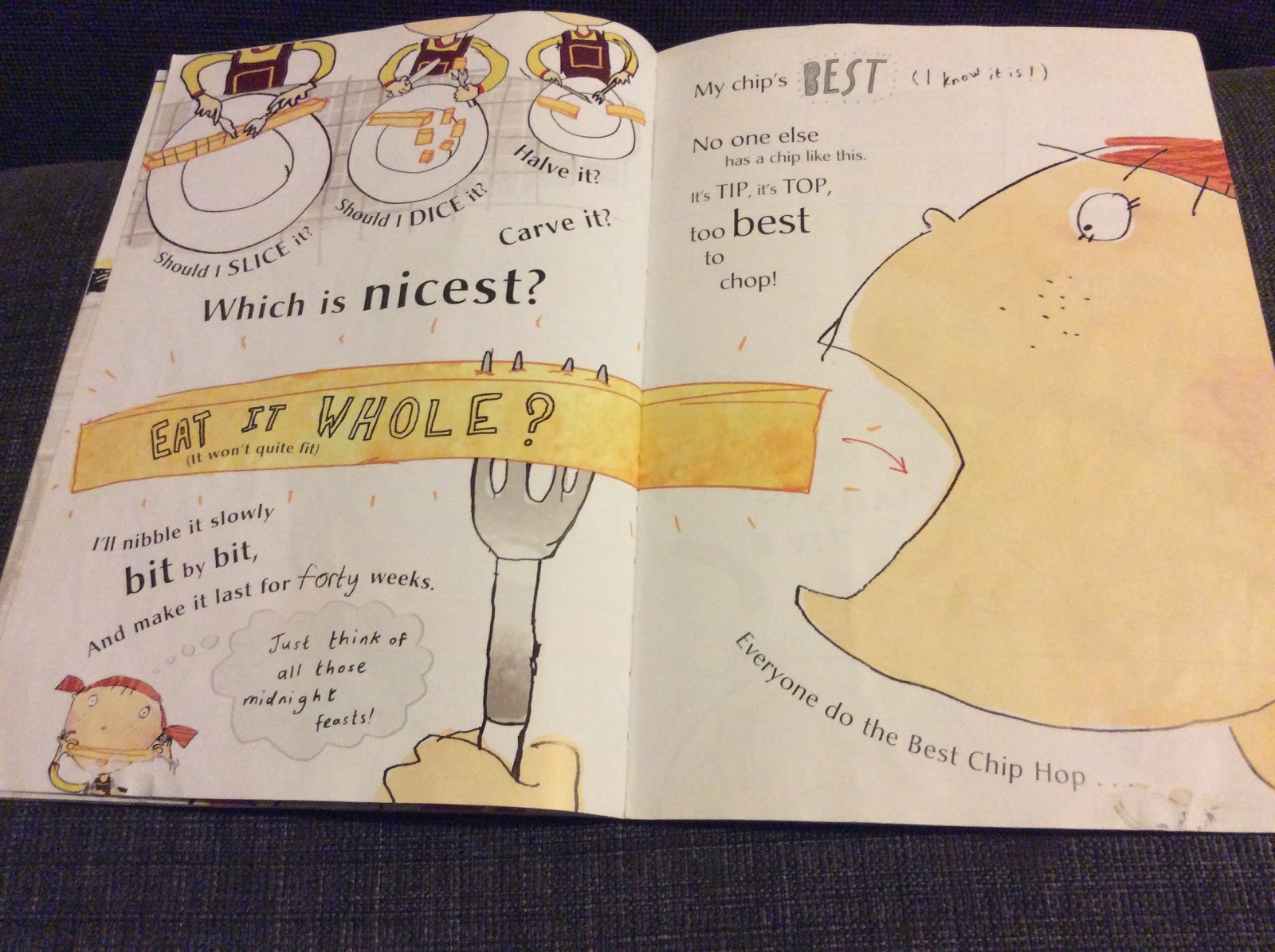
This is one of my favourite books of all time, and quite possibly  #myinheritancebook. If you like modern poetry or even rap, this is the picture book for you. The rhyme is sublime!  It's fast, fun, tells a fantastic story and covers all manner of emotions (exhilaration, excitement, trepidation, sorrow); it's dynamic and comedic, all in one. 

The story rhyme tells the story of a little girl and her family standing in the queue at the fish and chip shop, then being served their chips, and the little girl savouring their taste, their look and their feel and then dropping her favourite chip in the floor. It looks like certain disaster, but the little girl soon recovers when she's served her other favourite food, ice-cream! 


Kate Leake works mastery over words in this book, it's a huge pleasure to read aloud, it rolls from the tongue. She uses alliteration on the 'ch' sound in the opening few pages, which are soft and lyrical. This sense of hysteria around the ' whopper' chip starts to build mid way through, as we're lead through excitement in the first person by the anticipating girl. The pages are laid out in a fun, engaging manner, comic book-like with capitalisation at random 'impact' moments, words in bubbles and sentences scattered uncouthly around the page, the the reader is forced to work hard for the best read, and I like this. 


In terms of the illustrations, again the lay-out and scale of pictures differ on each page and are stimulating on the eye. The children love trying to follow the read with their fingers, but I read this book so much,  they can't keen up, and it becomes even more fun and frantic in terms of reading and chip eating. 

The book works well if you put a touch of performance in, over playing the loss of the bestest chip, with dramatic sobs. Children from 2-7 years love having this read to them. My only very minor criticisms of the book; there's a lot of mild yellow in the pictures, so not so eye catching, and I sometimes feel it's a page too long ( but mainly only if the 'performance' is especially dramatic!- phew, exhausting!) 
All in all, a really lovely book for sharing with all the family. 


Saturday, 11 February 2017

Henry and Mudge: The First Book


Author: Cynthia Rylant
Illustrator: Sucie Stevenson
Publisher: Simon Spotlight, 1987, edition featured Aladdin Paperbacks 1990

I know very little about this author (I just looked her up: Cynthia Rylant) and very little about the educational context of this 'ready-to-read' series of books ( Henry and Mudge), but I absolutely love this book, and I'm cherishing passing it on to my children. 

Henry and Mudge: The First Book is about a young boy, Henry, who feels lonely. He has no siblings nor friends in his neighbourhood; he asks his parents for a dog. His parents agree, so along comes Mudge, a puppy. This puppy grows into a huge drooling heavy-weight of a dog and a lovely friendship between boy and dog is forged, seemingly impenetrable. There's a humourous 'growing up' moment in the story when we see all the collars Mudge grows out of, before meeting giant Mudge himself. This sweet, charming story is so well written, it reads aloud so effortlessly as an adult, and with its many moments of pause and reflection, it reads easily to the child as well. Bert read the series when four and a half years old, and he was a fair to good reader at the time. It's an ideal book as part of the Summer Reading Challenge, as one of many in an American early years reading scheme.

Now what I especially like about this man and beast relationship, is that it's shown to be reciporcal, so dog Mudge, loves Henry as much as Henry adores Mudge. They spend all their time together, sharing the same bed, smelling each other, lying on each other. 


Henry gains confidence through having Mudge, described concisely yet poetically: 


Rylant's economy with words is Orwellian. She gets across the idea perfectly, with no unnecessary exposition. As an early reader these books are perfect, very short smart 
sentences, interesting vocabulary but most importantly a gripping story. I remember my heart beating in my head reading these books as a child, wondering if Henry will find Mudge once Mudge goes missing in the wood. Rylant sets up this moment of loss and worry so nicely, showing how the landscape suddenly seems big and empty, showing the desperation in Henry as he shouts and shouts for his dog. The pastel watercolour and pen illustrations feel a tiny bit dated, but mainly thanks to dad's handlebar moustache (though admittedly back as a fashion faux pas again currently). Saying this, I like how Sucie Stevenson has captured a sense of flow in the tree detail and the idea of a vast lonely sky with the formation of birds migrating overhead in the Mudge being lost scene. 

The ending of the book is also suprisingly solemn, with Rylant reminding the reader about the fear and loss Henry felt when Mudge was missing. As such, this story really stays with children; after reading it yesterday Bert asked if we could get a dog (fairly predictable), recalling how Mudge was Henry's best friend. He said that in the story Henry had learnt how much he loved Mudge, especially when he was gone. Loyalty, and valuing friendship then, is a theme children take from this book. 


Monday, 30 January 2017

Peepo!


Author: Alan Ahlberg

Illustrator: Janet Ahlberg
Publisher: First published by Viking 1981, published in Puffin Books 1983, Published in the edition featured 2004

It's National Storytelling Week and I'm all excited as I'm about to go into Edie (3) and George (1)'s nursery to read to the children.  Now I know I only posted a book from The Ahlberg writing duo last week, but as 'Peepo' is one of my favourite books of all time, and will join in on my nursery reading adventure, it felt only just to feature it tonight.
I should make a disclaimer that 'Peepo' entered our house as a gift on the arrival of my second son, so it's tied up in a real personal joy for me, and despite myself I always feel teary when I read this book.
I think that beyond the personal sentiment the book brings a tear to my eye because it captures an era so beautifully, so wisely, that no other film nor book set in this wartime period does so well. This is the life of a baby, seen through the eyes of that baby (emphasised by the cut out 'vision circles' on every other page). This baby perceives itself as surrounded by family, two sisters, mum and dad and gran. This is kitchen-sink life on the homefront during the Second World War, not the more familiar depiction we associate with these times of trench warfare, battle, Blitz aftermath. For the baby it's an unremarkable time, just life, normal, everyday. The baby notices the little, incidental things like 'the hairnet his mother wears in bed', his 'sister squabbling, She wants him on her knee,' the 'tassel's on his grandma's shawl', 'his ball and his teddy'. In every illustration in this book there's a detailed 
plethora, an archive of artefacts from the time. This book is a feast of nostalgia, a catalogue
of urban life in the family during the war, and strangely, as a child on the 1980s I remember 
so much of the furniture, the household products, the items of that time, as my own postwar baby boom parents had inherited 'this stuff', these ways, this look. I remember my own great grandmother, the very image of this shawl clad, hat pin wearing grandma in Peepo. 

Now the problem for my four, all they hear me say when I read this book is, 'look, mummy 

had a bed like that when she was little', 'mummy had a coal shed and outside loo like that in 
her house when she was a girl' (disclaimer: I grew up in a rural cottage so not all 1980s born parents will think like me on this one!) The children used to do well to listen to my ramblings fairly attentively, I think it was white noise to them really, they were too bewildered by the very busy detailed pictures, trying to spy the tiny 'incidental' (in the baby's eyes) image of the war planes on the 'park outing' page, but recently 7 year old Alf has started groaning, 'not this book that's all about you again !'... Fair point! 


So why recommend this as a read and bring this one into a children's nursery?  Because it 
works on so many levels: this book is fun (our 1 year old just hear's the repetition of the word 'Peepo!' , it's moving (OK, more so for adults), it's educational (a history lesson in every sitting*), and the rhythm, cadences and rhyme in this book- sublime. It's lilting, song-like language; I find it so easy to read aloud and share with children. I think I'll always be so grateful that this book entered my life, the least I can do is pass it on. 

*Bert (5) informs me that his class looked at the following page of Peepo this week to look at 'things in a kitchen', I was surprised myself by how much he identified, so how much of our lives are therefore the same and not so distant from this time.  


Related Posts Plugin for WordPress, Blogger...