Search This Blog

Showing posts with label exciting. Show all posts

Thursday, 27 July 2017

The Tickle Book


The Tickle Book with pop up surprises

Author: Ian Whybrow 
Illustrator: Axel Scheffler

This book, together with The Bedtime Bear by the same author and illustrating duo, are by far the most loved and well read books in my house. So well loved in fact, I've bought them three times over (each!) and since the summer days have now befallen, the kids being at home ( sheltering from the summer rain) so much more, I find myself putting in my order for a fourth copy of The Tickle Book tonight...and really, they're pretty robust for 'pop up' books! Nonetheless, the absolute excitement and joy a good old fashioned lift-the-flaps, pull -the- tab, pop-up book seems to bring (any age child, in fact the older they get, the more excited by the pop-up aspect they seem to be), dumbfounds me. The pure suspense of the pull, for my seven year old, has him in squeals of delight every time. 


I can't recommend these two books more highly, they're such a pleasure. Bright, loads of fun, very quirky ( why is a lizard in a blizzard? Why is there a rabbit on a motorbike?) , ah the countless questions I have for the author...situational madness ' a mouse motel' and a ' lynx carrying drinks' to a picnic, brings humour with every read. And yet as each book follows a jouney to tickling bedtimes, the menagerie of characters and places all seem to make bizarre sense, fuelling the excitement further. The rhymes are very catchy, with a staccato beat and optimal use of rhetoric. There's also a play on phonics that's a preamble to the now very popular Kes Gray 'Oi' books ( e.g. Oi Frog!) , so an 'owl in a towel' and a 'snake' with a 'cake'. The word choice of the author speaks to toddlers beautifully, plenty of 'hello' and farmyard / animal noises. These are the type of silly rhyme books kids really remember, with invitations and instructions to tickle, close eyes, say goodnight. As such, fantastic books for helping build attachments, for bonding, perfect for adopters. My older children currently love reading these to the younger ones, squeals and giggles of laughter amount, hence the wear and tear on the tabs. I also like that there's lots of different lift flap, pull tabs and card wheel arrangements in the book, it really does make for a 'pop up book  full of surprises.' Big thumbs up from me, but buy three copies at least as you'll get through them, and sadly these books are no longer on constant sale in the big supermarkets, like a few years ago. 


Tuesday, 4 July 2017

Edwina the Emu


Author: Sheena Knowles
Illustrator: Rod Clement
Publisher: Angus Robertson, an imprint of HarperCollinsPublishers, 1996

I was passed this book on a bookstall at a school fayre; 'here'said the bookstall mum, 'you'll like this one, it's about a feminist emu, and it's pretty funny'. And she was right, it's really funny, Australian dry humour funny, and a 'feminist emu', why of course!
With loud, brash and garish illustrations, we meet Edwina and Edward, emus in love and expecting a brood of ten. On realising the news Edward shouts, 'YEEK!' and so starts the catchphrase of the book: 'he seemed to be choking, 'Ten litttle emus? you've got to be joking.' being the more collected of the pair, Edwina offers to leave the nest and go and seek work, in order to afford the brood. Edwina tries several jobs, as a ballerina, a chimney sweep and as a waitress. As each ends in an emu related drama, Edwina realises her calling is to sit on the nest (part time only, in a job share with Edward!)  I love this portrayal of a strong, independent thinking, progressive female, and the turn the story takes without compromising the central protagonist's empowerment. 


The bawdy carictures of other job seekers fit well with the laugh-out-loud storyline, an emu being equal to man in a queue at the bus stop, for example. The text is fun also, with simple rhyming couplets ( Some times the rhyme itself is a little over worked and tenuous, but again, this adds to the amusement!) The book looks and feels very Australian, with this loud swaggering humour and moments of irony, such as Edwina gettting a job as a chimney sweep and using her body to sweep the the whole chimney. 

My daughter dislikes Rod Clements' use of starring, googly and bloodshot eyes, which do, I think, put young people off the book. The faces of shock in the book, just aren't the more refined British interpretation of 'shocked face', they're too confrontational. The messages in the book are, however, hugely welcome, insighting a positive sense of womanhood, and promoting shared roles and duties as parents. I like that when Edwina returns to the nest, partner Edward is exhausted; a commment on the stresses of running a home for either gender. 
All in all, an uplifting read, embracing working women and equality in relationships.


Sunday, 11 June 2017

The Queen's Nose


Author: Dick King-Smith
Illustrator: Jill Bennett
Publisher: Puffin Books, 1983

This is the most enjoyable chapter book I've read to my 5 and 7 year olds at bedtime so far. I read this to myself aged about ten, and recall moments of the BBC serialisation, but reading The Queen's Nose back to my children confirmed to me that this book has a real charm. It's well-paced, with chapters roughly ten pages long and some gripping cliff -hangers. Most notable is when protagonist, Harmony Parker, is cycling at speed toward a junction and doesn't see the sign. Gripping! My children kept asking all day, what might happen next. We looked forward to reading every chapter, a great accolade with children so young. 


The story starts by introducing school girl Harmony, whom we quickly learn is creative, thoughtful, and at odds with her family. Harmony imagines all the people around her as having animals personas, so her sister Melody, for example, is a self obsessed showy 
Siamese cat, she sees her mother as a fussy pecking Pouter Pigeon and her father as a busy performing Sea Lion. This proved a great plot device, with the children both trying to fathom which animals their teachers might be. Dick King-Smith packs his work full of rich description, particularly with regard to personalities, so inadvertently much improving my children's' vocabulary and desire to observe the world, and people around them. 

In the story, Harmony feels lonely, and yearns for a pet. She spends a lot of time alone, thinking, talking to her stuffed toys and the chickens in their coop in her garden. One day, bringing great excitement, her Uncle Ginger comes to stay ( she views him as a vivacious Grizzly Bear). Having built a mutual relationship, Ginger then has to return home, and on living Harmony, wraps her up a parting gift, a 50p piece that grants wishes once rubbed. So far, a sort of Alladin story, without the lantern. 

The build up to receiving the magic coin is suspense filled, with Harmony having to complete a treasure hunt, and then work out how to use the coin, followed by more complex  problem solving, that really carries the reader, such as how and when should Harmony spend her wishes. Harmony has seven wishes in total; although her wishes are continuously fulfilled, she learns many important lessons through making her decisions. She learns not to be rash, to prioritise those she loves, to be grateful for what she has, to see the good in people ( rather than all their negative qualities) and most importantly, she learns to keep dreaming, and believe and trust in others; fantastically humanistic messages in this hostile ideological age. 


When reading this book my children were really able to empathethise with how main character, Harmony, felt, as her dreams and wishes were well pitched and resembled  'real' children fairly universally. Harmony requests a pet rabbit, a bike, a watch and time off school. The adage 'be careful what you wish for' hungs in the air each time, as the wishes backfire to different extents due to Harmony's misguided management of the situation.

Harmony tries hard though, and diverts disaster by thinking of others, leading to a happy ending and the interesting question as to whether these events would have transpired anyway. With new confidence now, Harmony decides to give the coin away, tossing up on Wimbledon Common for the next person to find. My sons, Alf and Bert, loved this ending, wanting to immediately go searching for the coin. The only problem I found with the book, related to this, was that the coin described has been out of general circulation for some years, so unless we go hunting around in antique fairs, I don't expect we'll stumble on the 'real' coin any time soon. Though this might be a good thing. 
An inspiring, exciting read, ideal for reading to siblings as there were many talking points about the sibling relationship in the book discussed. I think we'll return to reading this again fondly in a few years, it was a big success. 


As with The Demon Headmaster The Demon Headmaster by Gillian Cross
 and The Worst Witch by Jill Murphy this leaves me to call the BBC to #BringBackTheQueensNose! https://youtu.be/5Chicdij_dU

Wednesday, 10 May 2017

First Greek Myths - Jason and The Golden Fleece


Author: Saviour Pirotta
Illustrator: Jan Lewis
Publisher: Orchard Books, Hachette Children's Books, 2009

I've been excited about reviewing this book for a while, or more so, Pirotta's First Greek Myth series from Orchard Books. These books were the first books Alf (3 years old at the time, but 7 now) requested we borrow again from the library (music to my ears). These were also the first books I found Alf trying to read himself, unprovoked (again, a really special moment for a mum bookblogger). As part of the Orchard Colour Crunchies series these books are intended as 'early readers' but personally I think they need a shout-out as possibly the best books for emerging g independent readers, they're exciting, the perfect length, great illustrations (fascinating, maybe a tad scary, but that's part of the appeal), and full of the essence of adventure: fights, swords, monsters to defeat, voyages, magic, wishes made, promises broken. I'm a fan, and testimony to the longevity of this series, when I left the featured title on the sofa last night, ready to review, Alf picked it up and said, 'ah great! I love these books! Can you read this to me now?' (Recommended reading from 3 years to 7, and upwards and counting then!)


Interestingly, and as a nod to promoting more female leads in children's literature I like to think, in Jason and The Golden Fleece, Pirotta frames the main character not as Jason but Princess Medea, who is introduced first, and whom gets the final exposition on the closing page of the book. This is refreshing, especially as a rewrite of the male-hero binary that normally dominates adaptations of the Greek Myths. Medea is even portrayed as superhero-like with the text declaring, 'At last the powerful princess was free' supported by a picture of Medea looking majestic, with hands held aloft. My three year old daughter approves, and like her brothers, requests this title specifically.  


It's worth saying that each book in the First Myths series starts with a 'cast list' displaying two of the key characters in the book, and how to pronounce their names phonetically. Again this is useful for emergent readers, and for reading adults alike as some of the Greek names are impossible sounding in appearance to say on first reading.  

As the story of Jason and The Golden Fleece is so well known I won't linger on the narrative, only to say that in this version, unlike other children's versions of this myth I've read,  Medea is instrumental in every aspect of Jason winning the Golden Fleece (how postfeminist!)Though this empowered portrayal of women doesn't always transcend in this series: in Theseus and The Man-Eating Monster, for example, poor Ariadne is tricked and left on a desert island by Theseus (in other versions she returns on the boat with Theseus (and reminds him to put the white sail up, which prevents Theseus's father from killing himself). Personally, while it's great to see a positive, strong female characterisation in Medea, I also like the darker interpretation of the Myths. The Greek Myths themselves should be essential reading for any child, they're captivating, and the cornerstone of modern narrative conventions (or so I've read before). 

Beyond being perfectly concise and full of well chosen 'early reader' appropriate vocabulary,  I also like these books for the illustrations, particularly the many head shots with expressions told in the eyes. My eldest son really dislikes drawing, but the cartoon-like nature of the humans in this book inspired his attempt at a potrait based on one of the head shots. The illustrations are simplistic, bright and effective, with the layout of each page uncluttered, and so consecutive reading passages are easily signpost. 


In all then, these are exhilarating short reads. I'm so grateful to my local library for stocking these and in so doing, introducing me and my children to this fantastic series. I think they'd be perfect for supplementing reading in school libraries for KS1.  
If you like the representation of strong female leads in children's literature mentioned here, you might also like: Princess Smartypants by Babette Cole

Here are all the titles in the series (I bought them all as I had to stop borrowing them again and again from the library):

And thanks to starting out on these really simple condensed versions of the Greek Myths, Alf (7) now loves the 1963 Ray HarryHausen Columbia Pictures production of 'Jason and The Argonauts'. This film is a great way to support the reading, and vice versa.


Watch exerts from the film here: Jason and the Argonauts (1963)

Saturday, 4 March 2017

The Best Chip


Author and Illustrator: Kate Leake
Publisher: Macmillan Children's Books, 2006

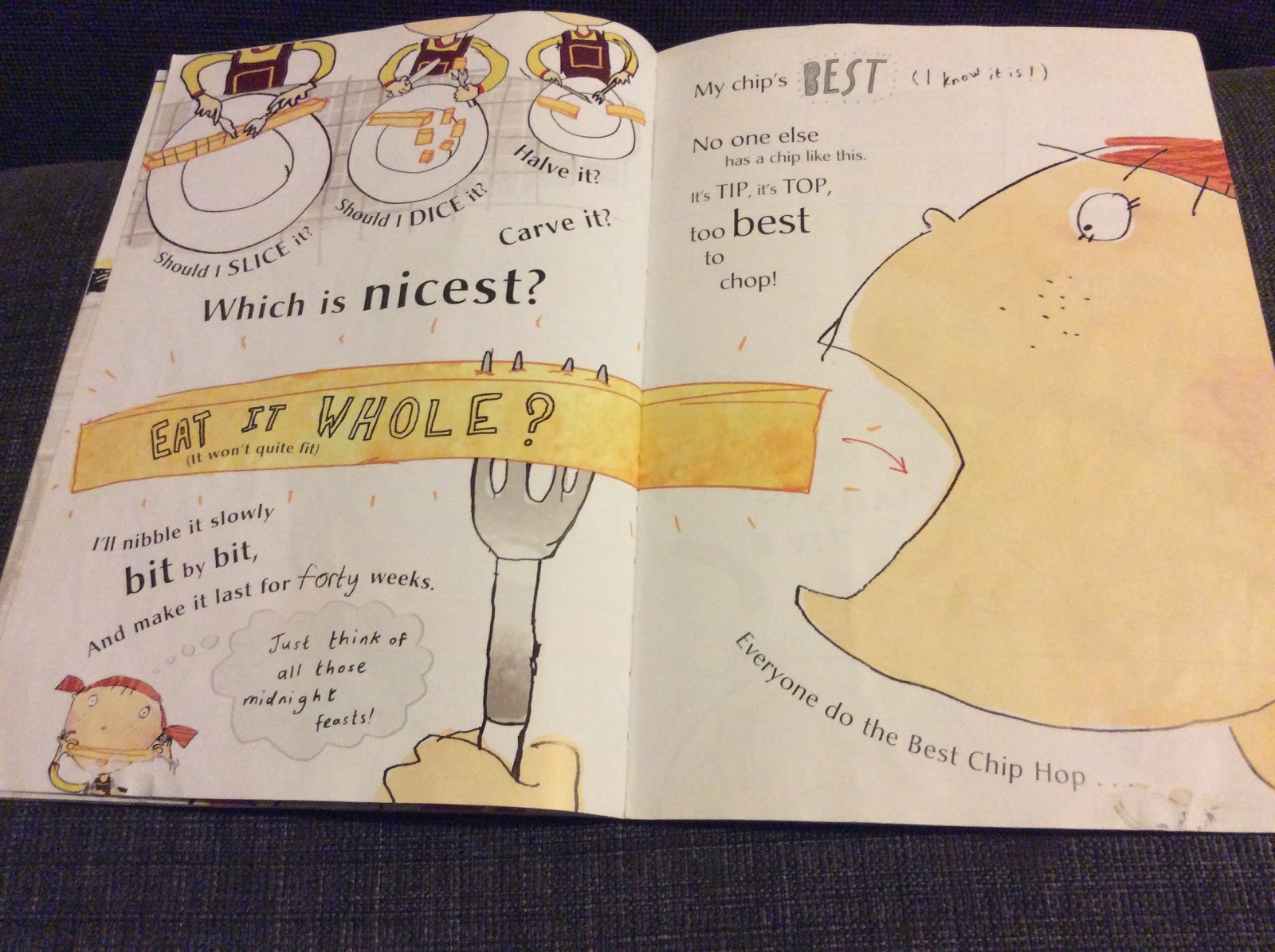
This is one of my favourite books of all time, and quite possibly  #myinheritancebook. If you like modern poetry or even rap, this is the picture book for you. The rhyme is sublime!  It's fast, fun, tells a fantastic story and covers all manner of emotions (exhilaration, excitement, trepidation, sorrow); it's dynamic and comedic, all in one. 

The story rhyme tells the story of a little girl and her family standing in the queue at the fish and chip shop, then being served their chips, and the little girl savouring their taste, their look and their feel and then dropping her favourite chip in the floor. It looks like certain disaster, but the little girl soon recovers when she's served her other favourite food, ice-cream! 


Kate Leake works mastery over words in this book, it's a huge pleasure to read aloud, it rolls from the tongue. She uses alliteration on the 'ch' sound in the opening few pages, which are soft and lyrical. This sense of hysteria around the ' whopper' chip starts to build mid way through, as we're lead through excitement in the first person by the anticipating girl. The pages are laid out in a fun, engaging manner, comic book-like with capitalisation at random 'impact' moments, words in bubbles and sentences scattered uncouthly around the page, the the reader is forced to work hard for the best read, and I like this. 


In terms of the illustrations, again the lay-out and scale of pictures differ on each page and are stimulating on the eye. The children love trying to follow the read with their fingers, but I read this book so much,  they can't keen up, and it becomes even more fun and frantic in terms of reading and chip eating. 

The book works well if you put a touch of performance in, over playing the loss of the bestest chip, with dramatic sobs. Children from 2-7 years love having this read to them. My only very minor criticisms of the book; there's a lot of mild yellow in the pictures, so not so eye catching, and I sometimes feel it's a page too long ( but mainly only if the 'performance' is especially dramatic!- phew, exhausting!) 
All in all, a really lovely book for sharing with all the family. 


Sunday, 19 February 2017

Tom and the Island of Dinosaurs


Author and Illustrator: Ian Beck
Publisher: First published 1993 through Doubleday, featured edition Picture Corgi, Random House 1995

For me this book has all the ingredients of a perfect children's picture book. Firstly (and in no order of priority), plenty of adventure, excitement and a good rescue mission storyline. Secondly, sumptuous illustrations with a lot of texture, depth of perspective and landscapes that feel very epic. Thirdly, whimsical characters- a boy who commands his own hot air balloon (and in the subsequent sequel, a raft), a girl on a desert island saving dinosaurs, and a grandfather, living in a lighthouse and ready to listen to his grandson's stories. As plot devices go, Ian Beck has created a plethora, all pitched beautifully at the curious minds of children; at every turn there's a new idea to fuel the fantasy, a volcano erupting, magic flowers to attract dinosaurs, a struggling baby dinosaur to help. What this achieves is a very gender neutral book, with plenty of fixes in the story to interest across gendered reading norms. My daughter (3) for example, loves the idea of a message in a bottle, the rescue itself, and dinosaur protector and architect of the plan, being a female lead. My son (5), loves the exploding volcanoes and the idea of character Tom, braving the elements alone to perform a daring rescue.  


As I said in my review of Benedict Blathwayt's The Little Red Train series, it's rare to find in children's literature, a writer who writes as well as he illustrates, but in Ian Beck we have that very thing. Beck uses lots of hatching techniques, mainly through exposed cross hatching, dipping and ticking penwork to create very textured, layered pictures. He is generous with his picture-per-page ratio and there are plenty of big double spreads in this book that wow; my children particularly like the dramatic volcano erupting page in this title. Beck has a real talent for drawing sea, cloud and smoke especially, which offers a lot of depth and movement to the page, his work is really captivating. 


To find fault with this title I would suggest that the type-font or type set of the book is dated, I think it's written in Times New Roman, which I find hard to read personally. And while I like the pace of the book, as the story always grips my children, there is a lot going on, and such a complicated plot in a very compact exposition, might be confusing to some. The plot is a little frenetic, very fantastical and takes a confident reader to interpret which sections of the narrative to emphasise. When 7 year old Alf read Tom and the Island of Dinosaurs to his siblings a few days ago, it sounded like there was an exclamation mark after every sentence end, as to him, every moment in the book was remarkable and worthy of expression. (And I would agree). 

In all, a hugely enjoyable book, perfectly matched at the 3-6 year old market, and I'm sure it's inspired many a dream in our house; my middle two children have certainly role played at saving dinosaurs (with the carpet as the sea) following reading this book.  

Saturday, 21 January 2017

Tyrannosaurus Drip


Author: Julia Donaldson
Illustrator: David Roberts

Publisher: Macmillan Children's Books, 2007

This is Julia Donaldson at her very best. An exciting 'underdog wins' story wherein a vegetarian duckbill dinosaur egg ends up in a Tyrannoasaurus nest. The hatchling does his best to fit in with the meat eating T Rex family, but instinct takes over and the T Rex family want to hunt while the duckbill runs away. 'Drip' as the duckbill is named, accidentally discovers his heritage and then saves the duckbill herd from being eaten by grisly and grim T Rex's when they strike lucky with a new way to get across the river. 

The illustrations in the book are a little chaotic, and according to my five year old tonight, 'don't look enough like real T Rex to be a T Rex' ( the caricature of small arms, sharp teeth, claws don't really go alongside the pink plump bodies), the rhyming narrative is fantastic though, and just rolls into rote. Children probably get slightly more out of this book if they understand a 'reflection', in that dad T Rex falls into the river after seeing his, but the way this book reads aloud (sumptuously) means it's suitable for a broad age range (as is the case with most Donaldson books, the secret, in part, to her success I think).  

I'm not sure the book promotes any helpful messages, 'nature over nurture' (not sure I agree with this one), 'running away to find oneself' (not a message I'd normally advocate in a children's book), the tearful looking T Rex family on the back sleeve always rouses sympathy and questions from my children too, 'what happens to the T Rex family mummy, do they find food?' So possibly not the most well thought-out children's book, but in terms of oral and aural readability - divine. 

Sunday, 15 January 2017

One Lonely Fish


Concept and Design: Andy Mansfield
Illustrations: Thomas Flintham
Publisher: Templar Publishing, 2016

The full title of this book is: One Lonely Fish: A counting book with bite. It's one of my current favourite books for toddlers, and works especially well for those approaching or a few months following the age of 1, with a very straightforward concept (count-the-fish) and pages that can be easily turned by small hands.  

Counting gradually up from 1-10, on each page the landscape length on the book gains a new colourful fish, with its jaws wide open, enough to swallow up the fish ahead. This forms a neat queue (or chasing line) of fish until one giant fish eats the lot (broad smile on his face). Snap! The end. 


Following on from reading (though it feels more like playing with this book, rather than reading it), we've used the book to discuss why fish number ten might be lonely, and with older children, you might even get a chat about the food chain out of this this title. 
In terms of age range though, this is an exceptionally toddler-friendly book, as the pages are easy to turn with inverted triangle card cut-aways on each page for added 'turn-ability', and the pages are made of tough thick cardboard. It's a big robust book (a bit too big for standard bookshelves actually, so do think about finding accommodation for it elsewhere in a nursery bedroom). The fish illustrations are bright, predominately in primary colours, and the big jaws perspective on the final fish is playful. My three year old loves 'reading' this to her younger brother, and spotting the red crab on each page too. There's extra fun to be had if children dare put their own hand in the fish's mouth, and it bites shut. Lots of squeals of delight in my house from this book in that biting-hand off respect. 

One Lonely Fish feels a little like a hybrid between to Rob Campbell's 1996 Fishy Things and Rod Campbell's 2005 Touch and Feel I won't Bite. If you like both these titles you'll love One Lonely Fish too. 


And if you enjoy counting books with toddlers I also recommend this video of the band Feist singing 'counting to 4' on Sesame Street, uploaded to YouTube in 2008. My children love this rendition, but be warned, it's very catchy: Feist: Counting to Four video


Related Posts Plugin for WordPress, Blogger...