Search This Blog

Showing posts with label performance. Show all posts

Sunday, 26 March 2017

BANANA!


Author and Illustrator: Ed Vere
Publisher: Puffin Books, first published in 2007, board book featured edition 2008

My eldest child, Alf, is 7 years old and loves a spot of drama: thanks Ed Vere, I feel you contributed to this. BANANA! came into our house when Alf was a few weeks old. With a sparse collection of children's books in the freshly painted nursery, we reached for this board book, again and again. At first we didn't really get it, the book nor the baby. The baby didn't do much but we thought we should probably read to it. The book didn't say much, but we thought we'd better read it. the basic synopsis- two monkeys, one banana, two words (banana (capitalised and followed by various modes of punctuation- !,?,!!) and please (followed by - ?) So instead we 'read' the pictures. This involved describing the pictures at first...no interest from baby. This then evolved into enacting the monkey's gestures (arms aloft, see picture below), making the blase whistling noise for monkey-not-noticing-pleading-monkey (again, see below)...sudden flicker of interest from baby.  


Okay, so there we had it, BANANA! was a book to be performed! 12 bright double page illustrations telling of the complex negotiation around the eating of one banana. Simple and effective. Sometimes my partner and I (newly doting parents might I add) took on reading roles; one of us would be monkey one (stripey red T shirt monkey) who takes to tussling for the banana with monkey two (stripey blue T shirt monkey). Except this would often end in a fight as red monkey, having the epic tantrum on page 5 (see below), was a far more interesting performance role to play compared to blue monkey, who's a bit of a goody goody, and is the first to agree to share. 


This book taught me many things. It's a masterclass in 'less is more'; short,colourful and economic with words. It taught me that a good story for young children, is about the performance and delivery as much as a narrative. BANANA! pushes the adult reader to interact with their audience; to imply, interpret, gesture, offer, initiate and model behaviours in order to tell the story (its an impossible book to simply read- too few words). Indeed BANANA! facilitates the basics of learning to read beautifully, asking that the reader interpret the pictures, recall events, and 'read the illustrations' in order to follow and impart the gist. BANANA! is funny, and engaging; it seems the bigger the read-aloud performance of this book, the more of a reaction you get from children. Having been a fan of the book for 7 years now, my version of the monkey tantrum is raucous, big movements, big facial expressions, gets lots of giggles. Its an enjoyable book and a joy to share. 

This book also has a huge amount of educational scope. It helps promote giving names to emotions, labelling and identifying different emotions even for children at a very young age. BANANA! is so simple I would suggest it's suitable for babies, toddlers even through to preschoolers, it might even have a place in a SEN library, and we certainly use this one to open discussion on emotions with regard to the children's adoption. Currently our baby of the house, George (20 months), stares in bewilderment at us, trying to fathom why we pretend cry when we read this book, why we storm off, why we smile at the end. It's a great book for being playful, role playing emotions, and as such is good for building attachment, for bonding, for showing parent-led emotions, and so I would also recommend this book as a resource for Theraplay. 

And finally, as if that doesn't pack a big enough punch for a 12 page board book, the final parting message of the book is to share, with the monkeys agreeing to disagree. This is a great way to end off a toddler board book, future proofing any sibling encounters along the way. And of course, throw a bit of maths in there for good measure too, as the monkeys and their banana halves mean "two halves make a whole"- fantastic, genius! For a book with just two words, BANANA! says so very much. 

BANANA! should also come with a warning though: my children frequently choose this title to 'read' to their youngest sibling, as it always raises a laugh: performance styles can vary and budding actors develop their own interpretation (usually the style known as 'over-the-top'. Given this, I wouldn't always choose this book at bedtime, as it has been known to 'hype' the children up. In all though, a big monkey thumbs up to Ed Vere for this humorous, clever offering. 

If you like this book, you might also like this 'performance' reliant board book: This is the Way by Charles Fuge


Saturday, 4 March 2017

The Best Chip


Author and Illustrator: Kate Leake
Publisher: Macmillan Children's Books, 2006

This is one of my favourite books of all time, and quite possibly  #myinheritancebook. If you like modern poetry or even rap, this is the picture book for you. The rhyme is sublime!  It's fast, fun, tells a fantastic story and covers all manner of emotions (exhilaration, excitement, trepidation, sorrow); it's dynamic and comedic, all in one. 

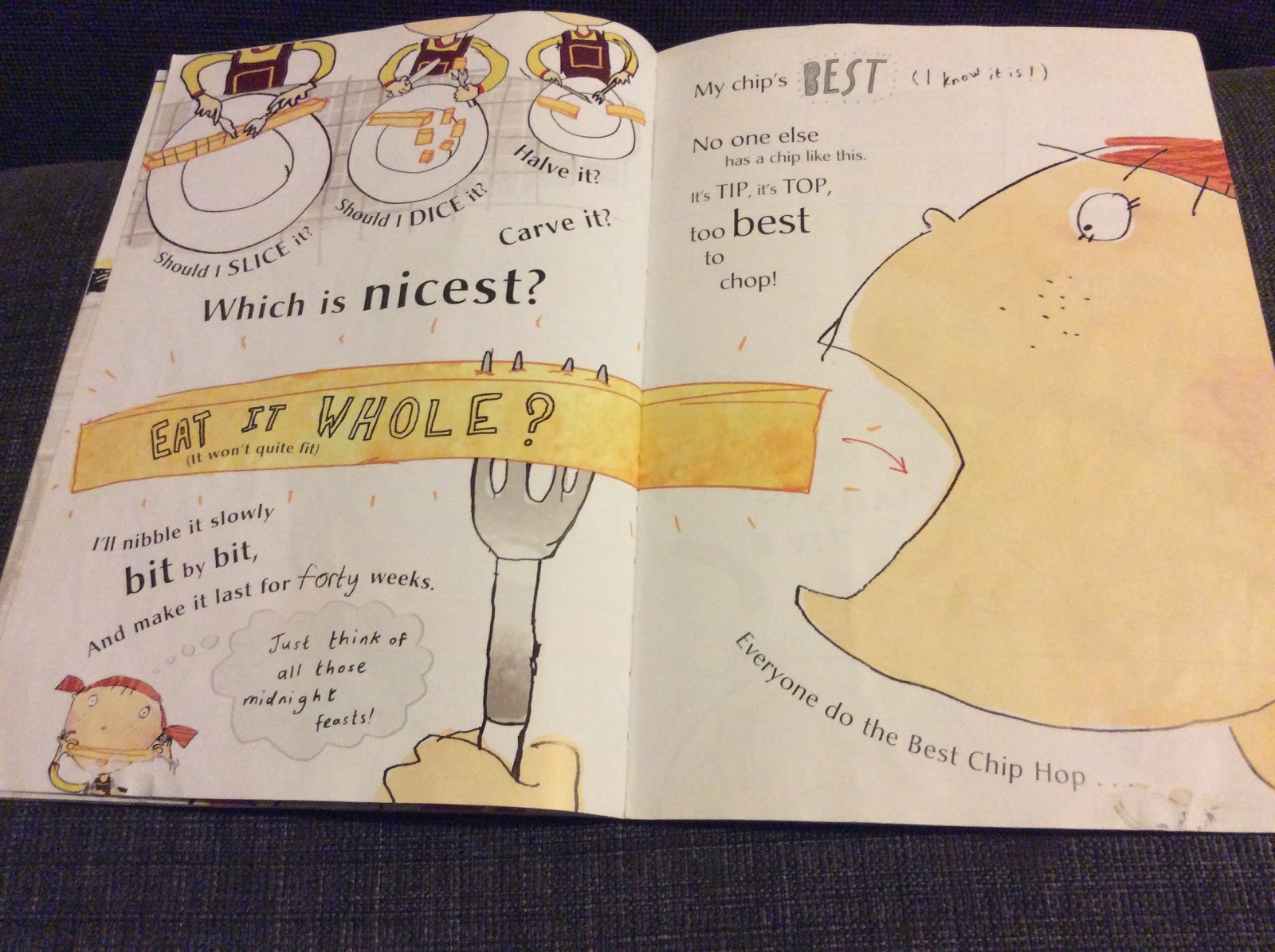
The story rhyme tells the story of a little girl and her family standing in the queue at the fish and chip shop, then being served their chips, and the little girl savouring their taste, their look and their feel and then dropping her favourite chip in the floor. It looks like certain disaster, but the little girl soon recovers when she's served her other favourite food, ice-cream! 


Kate Leake works mastery over words in this book, it's a huge pleasure to read aloud, it rolls from the tongue. She uses alliteration on the 'ch' sound in the opening few pages, which are soft and lyrical. This sense of hysteria around the ' whopper' chip starts to build mid way through, as we're lead through excitement in the first person by the anticipating girl. The pages are laid out in a fun, engaging manner, comic book-like with capitalisation at random 'impact' moments, words in bubbles and sentences scattered uncouthly around the page, the the reader is forced to work hard for the best read, and I like this. 


In terms of the illustrations, again the lay-out and scale of pictures differ on each page and are stimulating on the eye. The children love trying to follow the read with their fingers, but I read this book so much,  they can't keen up, and it becomes even more fun and frantic in terms of reading and chip eating. 

The book works well if you put a touch of performance in, over playing the loss of the bestest chip, with dramatic sobs. Children from 2-7 years love having this read to them. My only very minor criticisms of the book; there's a lot of mild yellow in the pictures, so not so eye catching, and I sometimes feel it's a page too long ( but mainly only if the 'performance' is especially dramatic!- phew, exhausting!) 
All in all, a really lovely book for sharing with all the family. 


Thursday, 23 February 2017

This is the Way


Author and Illustrator: Charles Fuge
Publisher: Gullane Children's Books, 2008. Featured board book edition, 2009.

Here's a fun board book that has really encouraged early language development in my children. This is the Way is simple action-noise book, very repetitive and very catchy. It's about a little boy (or girl, I can't quite tell...it's the 70s bowl cut hairstyle that's confusing) who follows behind various animals, copying the way they move with an action and sound. 
Some of the creatures the boy follows are slightly a-typical (for this sort of animal rhyme book), so a dinosaur and anteater for example, and the onomatopoeic noises they make are also a little uncouth (the dinosaur doesn't roar as one might expect, but he stalks and says 'snarl, hiss, gnash!')
I've found in the past that the flow of the rhyme works so much better in this book if you repeat the action-noise twice:
'This is the way the orangutan swings, Ooh,Ooh,Ooh! / adding - Ooh, Ooh, Ooh!' / And this is the way the tawny owl sings, T'wit, T'wit, T'woo!,/ adding -T'wit, T'wit, T'woo!'
: as my children tend to join in with the noise on the second repetition each time. 


At first the illustrations in the book put me off, particularly the boy/girl in corduroy trousers with big blue eyes as he looks very dated, but actually now I really like this about the book; the illustrations feel retro and quirky. 

Both the children and I like that this very short board book has a real ending, a 'reveal' nonetheless, as on the last page the boy is fast asleep in his bedroom surrounded by inspiration for his imaginative creature reenactments; his cuddly toy is the tree-frog he meets, he has a bumble bee poster by his bed, his book is open on the anteater page. Most of my children have come to this realisation at about 2 years of age, and it brings them a real sense of satisfaction, making this connection.  

The book is perfectly pitched at the 1-18 month audience, but equally suitable (and more engaging maybe) with the 18 month-2.5 year age range. I distinctly remember Bert reciting the whole book at about 2 years old, making all the lovely animal noises, but we're a long way off that recall with George currently (20 months). 

The book really invites joining in, making noise, imitation, and performance. It uses a 'follow the leader' scenario that even young children will be familiar with,  and promotes a sense of parallel play, with the boy moving alongside the creatures; this again is very age appropriate for the toddler audience. In all, an excellent and highly recommended toddler board book. 

If you like this you might also like: Hug by Jez Alborough

Related Posts Plugin for WordPress, Blogger...