Search This Blog

Showing posts with label vocabulary building. Show all posts

Wednesday, 29 March 2017

Brambly Hedge: Autumn Story


Author and Illustrator: Jill Barklem
Publisher: HarperCollins 1980
Acquired: School Fayre

My daughter, Edie, (approaching 4 years of age) plonked Autumn Story on my lap today and said, 'I know it's long, but we've got all day'. Well what can you say to that?!

The book isn't 'long' per say, just quite wordy and descriptive, but that's part of the charm. The Brambly Hedge books are, to me, a hybrid between The Beatrix Potter Collection and The Thomas the Tank Engine series. They capture the essence of the British countryside in incredibly intricate illustrations like Potter, in attention to rural traditions, native animals, birdlife, insect life, flora and fauna just like Potter, and they're written in this slightly stiff, posh voice which hoots of Received Pronunciation. Characters are introduced by their titles, Mr Apple, Lady Woodmouse, Wilfred, and this espouses a sense of position and place in the social class hierarchy. Potter was slightly less oblique in doing this I'd say, some of her characters have more of an accent (Jemima Puddleduck) or aspire to great things (Mrs Tabitha Twitchit). And the similarity to The Rev W Awdry's Thomas the Tank Engine Series? In a similar vein to Brambly Hedge, I can read these books aloud and completely switch off to the story, sleep talk them almost. It's possible to read both series of these books so mechanically and yet still my children seem to enjoy them and beg for more! I have long thought that reading Thomas the Tank Engine at any time of the night or day would cure even a hardened insomniac.     
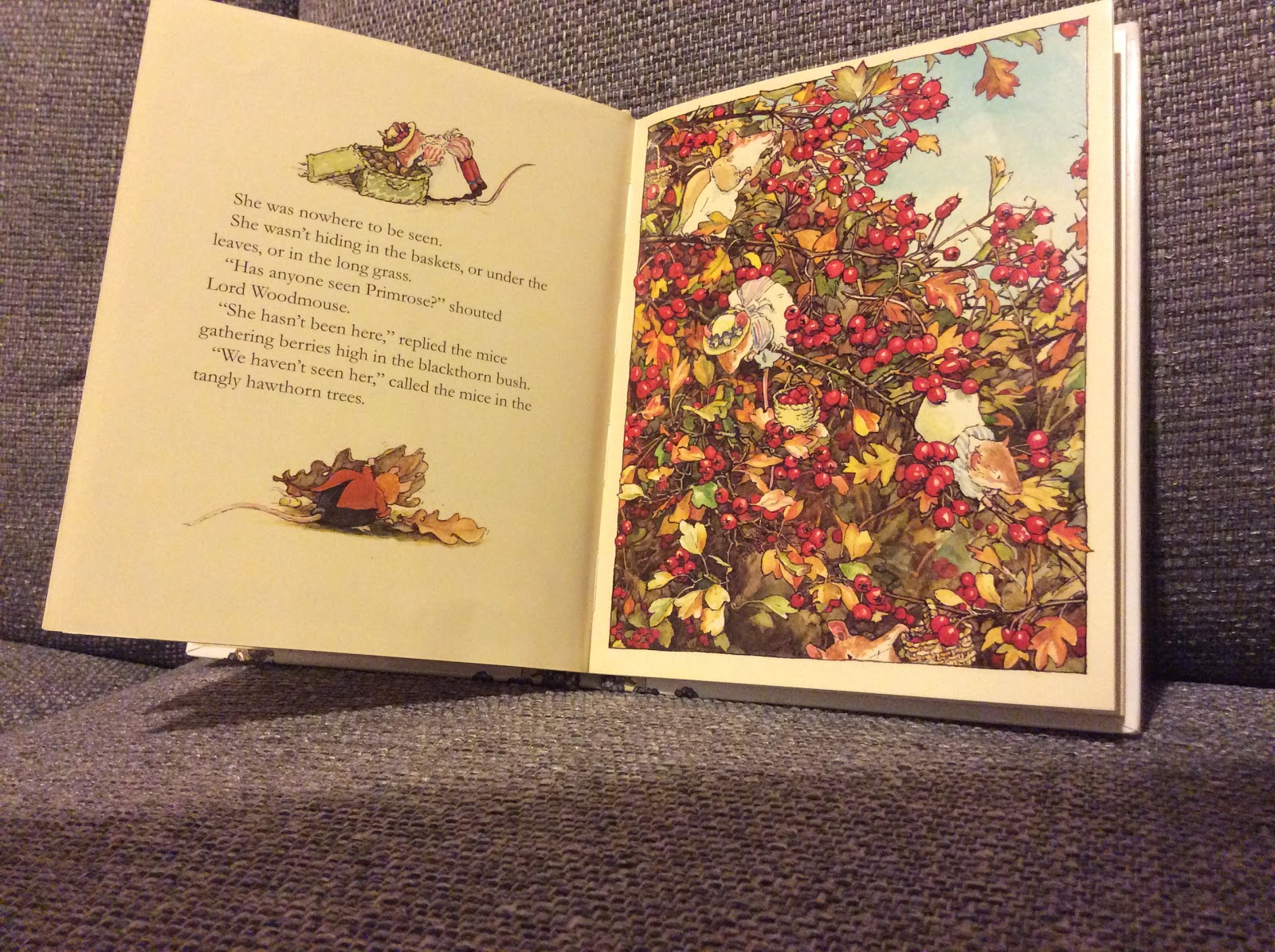


I will be lynched for gender specification here, but Brambly Hedge are really Thomas the Tank Engine for girls. Not to say that only boys like Thomas, and only girls like Brambly Hedge, not at all true, Bert (5) really likes a later book in the Brambly series called The High Hills (1986), but in general, I find the aesthetics and themes of Brambly Hedge really appeal to my daughter, while the aesthetic and narratives of Thomas continue to enthral my son. Again, the two series have much in common: both are about old alliances, community, teamwork, togetherness, friendship and work; both have exciting adventure elements, generally where something goes wrong and needs fixing, or someone gets lost of left behind and needs finding, or an item needs retrieving (against the clock). In Brambly Hedge: Autumn Story for example, field-mouse Primose accidentally strays too far; search parties are sent for her, but she remains resourceful and fortunate, and stumbles on other helpful mouse communities and is eventually reunited with her family.   


What I really like about these books, as does Edie who sat telling me all about this today, is the attention to food, clothes (the materials used), the weather, the smells. The books have quite a sensory appeal, being description rich, vocabulary rich. I also like that they appeal to girls (at least mine!) and have a strong adventure theme, and positive representations of female characters surviving on their own, being skilled and knowledgeable. The tone of the books are a little dated,  particularly in terms of dialogue whereby the characters address each other by name a lot and helpfully talk to themselves allowing the plot to develop. 

All in all, a good quaint 'summer's day in the garden' kind of read. 

If you like this book you might also like:  The Tale of The Flopsy Bunnies by Beatrix Potter


Friday, 17 March 2017

Eddie's Tent and How to go Camping


Author and Illustrator: Sarah Garland
Publisher: Frances Lincoln Children's Books, 2015

It's my unwritten rule on this blog to only feature books that have been on our bookshelf for a good three months (minimum), as I want to feature books that have proven longevity with young children. Eddie's Tent and How to go Camping is a library book we've borrowed for three weeks...I'm breaking with the rule here as Bert (5) has requested I read this book to him everyday this week, and so I'm keen to buy the other three titles in the Eddie series. 

Eddie's Tent is a fabulous mix of fiction and non-fiction which is proving very satisfying to Bert's early reader sensibilities. The book feels like the perfect read for 4-6year olds, as this seems to be the age children gain an interest in learning and sometimes reciting fact, with 'understanding the world around them' a feature of the early years British curriculum. The furore of camping also seems like an ideal reach to this age group, and has proved mightly appealing to Bert. This title offers both narrative about a family preparing and then embarking on a camping trip, and practical tips and skills needed for a successful camping trip. There's plenty of camping specific vocabulary such as 'pot hook', 'billy' and 'damper bread', placed in appropriate narrative context so offering implicit learning. I also like that the author pays heed to all the senses, adjectives related to and descriptions of sights, sounds, tastes, smells and the feeling of camping: 'When it was crisp and golden, they ate it with butter. Even the burnt bits tasted good', for example. 


The book is laid out in a way that maximises interest, with each short written piece accompanied by a small picture alongside. The simple pencil and colour illustrations have a child-like quality, they're not overworked or perfected, but resemble what an older child might achieve, so feel obtainable, 'copyable' to young enthusiastic hands (Bert has produced some great tent pictures himself this week, feeling inspired). Camping is itself a very aspirational activity for young children, so again, a great topic. 

We'd also read this book a couple of times before realising it refreshingly represents a blended family (or at least a non-nuclear family).  The parent characters in the book are 'Mum and Tom' and the two younger siblings, 'Lily and Tily' have similar names but different hair colour and skin tone. Later in the story Eddie makes a new friend, Max, who is spending the day with his grandad. The story is very idealistic, both families happy and gathered round the camp fire singing; togetherness and teamwork are welcome themes in this house though, given we're in a big blended family ourselves. 


The story goes off on lots of wispy tangents, which again really gripped Bert's interest. These tangents present family life as fun, so for example everyone practising handstands, sharing fish and chips from the van, and drinking  hot chocolate in the tent. There's also lots of suggests of activities to follow up the reading ( all implied), so for example, reading a compass, making dens indoors, and Eddie even sits down to draw a map of his journey at one interval. There's also a moment of suspense and high drama in the book as new friends Max and Eddie loose Max's puppy and chase him through woods, getting lost. Their newfound adventuring skills lead them to safety. As a really nice outro, the book includes 'some tips for camping' as an index (even though these tips are offered in short interwoven throughout the book too). 


In all, Eddie's Tent would make a brilliant addition to any early years or key stage 1 classroom. It's informative and imaginative, descriptive and explanatory at the same time. I just hope we can return our loan to the library without too much fuss, before our bought copy arrives.  

If you like this, you may also like (this other non-fiction): The Story of The Titanic (for children)


Saturday, 11 March 2017

KIDS


Written and Illustrated by: Catherine and Laurence Anholt
Publisher: Walker Books, Ltd, 1992

I feel truly privileged to own a copy of this book. I enjoy reading KIDS hugely, and laugh at the same parts every time (like meeting up with an old friend). The little quips in the book ('here's a kid who hid in some coal' - cue coal dusted child), feel fresh and fun, and despite being written in the 1990s, would be approved as 'PC' even today (I suppose the 'nasty' kids and 'nice' kids might get a bit of a redress in today's classrooms, but my children find these two pages of the book particularly amusing). Generally though being so in line with today's politically correct is incredible really, given that KIDS is about difference and similarity, the sort of topic where what's acceptable and how it's discussed changes rapidly and progressively (on the most part). 


Most importantly with this book, the authors were celebrating and putting diversity on the British children's literature map long before others (with the exception of Janet and Alan Ahlberg possibly, so for example, 'The Baby Catalogue'(1984)), and certainly before this became a part of a wider cultural and political 'agenda'. The differences between kids, as charted in this book, don't feel tenuous or contrived, but natural and not overplayed as those very differences are what kids have in common (nice!)


The book is structured as such, where on each page humourous observations based around a question are made, so for example, 'What do kids look like?' and then there is a reply, in this example 'freckles and badges and ink on their skirts, glasses and smiles and hanging-out shirts.' The Anholt writing and illustrating duo paint this lovely, rich anthology of childhood, showing how gaps in teeth, cuts on knees, getting in a muddle, hiding, stashing items in pockets, having fears, are universal. Alongside the Anholt's signature illustrations (ink and watercolour, detail on clothes, accessories, espousing diversity) the message created is, while kids might all look different there's plenty they do that's the same. 

KIDS is written in iambic tetrameter, so it sounds 'chugging', charging almost. I love that at the end of the book, parent characters are introduced, and they are portrayed as equally diverse, and in a hurry, and busy. On the last page of the book the rhyming verse starts with the letters to spell 'KIDS' in the vertical, and calms the charge right down with 'Kiss us when, It's nearly night: Dads and mums, Switch off the light.' Great memorable way to end and children's book and nice closure for bedtime.


In terms of age range, this book easily spans from 2-7years, and seems more appropriate as my children get older in fact. Alf (7) is all about 'adjective' collecting at school at the moment (this book is plentiful), and he's really starting to explore the concept of difference and similarity against himself - I imagine this is very age appropriate in terms of emotional development. KIDS is a great book for vocabulary building in general though, with the 'verb page' a favourite of mine (eg. 'What do kids do? mix, mess, muddle, comfort, kiss, cuddle'). (Shirley Hughes has a similar technique in her books 'Giving', 'Sharing' etc, as do The Ahlbergs in Baby Catalogue).

All in all, a fantastically educational book, ripe for using in the classroom to support all sorts of grammar exercises, perfect for sharing at home to promote discussion about 'who we are' (see also,If I Could Be),  and a book I like to reach for anytime of the day (like a guaranteed 'pick-me-up') (but preferably with a cup of coffee in hand).   

If you like this book about childhood, you might also like this: Peepo

Sunday, 8 January 2017

I-Spy: Every Vehicle on the Road


Every Vehicle on the Road 
Publisher: Michelin Maps and Guides 2011, created and produced by Blue Sky Publishing

I would like to see these Michelin I-spy books have a true renaissance as for me they're a must-have for pre-schoolers. They are so fun and easy to use and all titles in the range are loved by my 5 and 3 year old. Although not a fan of 'the list' himself, the 'I-spy football stadiums' title always accompanies 7 year old Alf on long car journeys too; the book is really helping build his knowledge of football clubs, their origins and the colour/ design if the kits. He sound like a mini social historian in the back of the car telling me about teams borne from working men's clubs. Many of the titles in the series contain snippets of general 
knowledge about the spot to accompany the sightings, fabulous for building young people's general knowledge and topic-based interests. 

I-spy are spotters guides, with each book containing roughly 120 pictures of things to spot and then tick off. Rare spots related to the title theme gain 50 points, with values decreasing in commonality. In I-Spy 'Every Vehicle on the Road' for example, the 50 point spots are a 'veteran car' (motor vehicles 1885-1905), and UNIMOG, whereas 5 point spots are very commonplace, including a hatchback, van and taxi. Once ticked off and the spot dated, the score can be combined to previous spot scores, with the aim of reaching 1000 points. Once 1000 points have been achieved, the adult can help the child apply for an online I-spy certificate at: www.ispymichelin.com. Each title also has 'cut out corner' coupon which can also be collected (5 needed) in order to apply for 'the Michellin badge' (a very sought after prize in our house). 


I've found these books promote using maths (adding scores, knowing values), support vocabulary building, promote greater  recognition and understanding of the world, and are an invaluable boredom buster in the car on any journey, not just long ones. The children do tend to need their own copy of the books though, as they're small and can't easily be shared, so they squabble over who gets 'to tick' or who saw the spot and should claim the points etc. We've bought multiple titles of popular books in the series, such as 'In the Garden' and 'At the Seaside'. 

These spotter guides are fun, bright, compact and have quite a cult hip status in the UK, or is it just me? They were popular in the 1980s I believe, and were reissued at the millennium. They also help children learn how to categorise and differentiate. Put your child on a diet of Michellin I-Spy books at an early age, and I'm convinced that they'll be fantastic at pub quizzes when they're older; a very worthy and useful social skill. 
Related Posts Plugin for WordPress, Blogger...